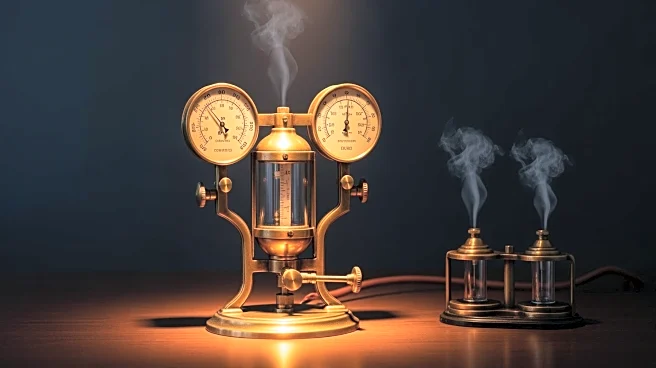




Benjamin Thompson, Count Rumford, was a pioneering figure in the field of thermodynamics. His innovative experiments and theories challenged the scientific norms of his time and laid the groundwork for future advancements in understanding heat and energy. Thompson's work not only revolutionized scientific thought but also had practical applications that improved everyday life. His contributions to thermodynamics remain a cornerstone in the study of physics,
influencing generations of scientists.
Challenging Existing Theories
Thompson's interest in thermodynamics began with his experiments on heat and motion. He observed the frictional heat generated by boring cannon barrels and proposed that heat was not a material substance, as was commonly believed, but a form of motion. This idea was revolutionary, as it contradicted the caloric theory that dominated scientific thought at the time.
In his famous experiment, Thompson immersed a cannon barrel in water and demonstrated that the heat generated by friction could boil the water. He argued that the indefinite generation of heat was incompatible with the caloric theory, suggesting instead that motion was the source of heat. Although his ideas faced skepticism, they were crucial in the development of the laws of conservation of energy.
Practical Applications and Innovations
Thompson's work in thermodynamics had significant practical applications. He designed stoves, fireplaces, and cooking utensils that were more efficient in conserving heat and fuel. His Rumford fireplace became a sensation in London, as it improved the efficiency of domestic heating and reduced smoke emissions.
Thompson's commitment to applying scientific principles to practical problems extended to his work in Bavaria, where he improved the diet and clothing of soldiers. He invented Rumford's Soup, a nutritious meal for the poor, and promoted the cultivation of potatoes in Bavaria. His innovations in cooking, heating, and lighting demonstrated the practical benefits of his scientific theories.
Legacy in Thermodynamics
Thompson's contributions to thermodynamics have had a lasting impact on the field of physics. His ideas about heat as a form of motion paved the way for the development of the kinetic theory of gases and the laws of thermodynamics. His work influenced later scientists, including James Joule and Hermann von Helmholtz, who further developed the concept of energy conservation.
Thompson's legacy in thermodynamics is evident in the continued study and application of his theories. His innovative approach to understanding heat and energy has inspired generations of scientists to explore the fundamental principles of physics. Thompson's work remains a testament to the power of scientific inquiry and its ability to transform our understanding of the natural world.