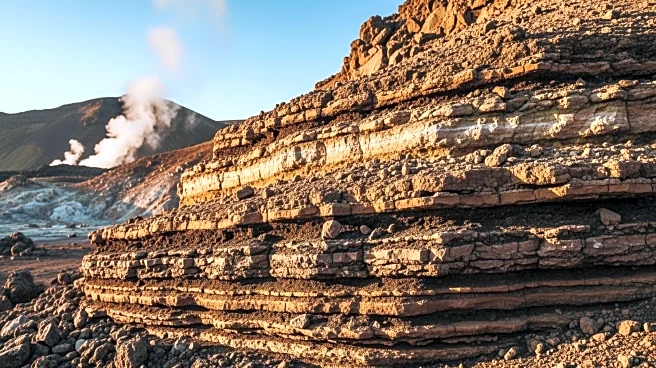

The Yellowstone Caldera, located in the northwest corner of Wyoming, is a geological marvel that has fascinated scientists and tourists alike. Known as a supervolcano, it is one of the largest volcanic
systems in North America. The caldera was formed by a series of massive eruptions, the most recent of which occurred 640,000 years ago. Today, it remains a dormant but potentially dangerous feature, with its vast magma chamber providing heat for the park's famous geothermal features.
Formation and Structure
The Yellowstone Caldera is a volcanic caldera and supervolcano situated in Yellowstone National Park. It spans approximately 55 by 72 kilometers, making it a significant geological structure. The caldera was formed during the last of three supereruptions that occurred over the past 2.1 million years. These eruptions were so powerful that they caused the ground to collapse, creating the large cauldron-like hollow that we see today.
Beneath the caldera lies a hotspot, a stationary area of intense heat in the Earth's mantle. As the North American Plate moves over this hotspot, magma rises towards the surface, fueling the volcanic activity in the region. This process is similar to the formation of the Hawaiian Islands, where the Pacific Plate moves over a hotspot.
Volcanic Activity
Volcanism at Yellowstone is relatively recent, with the caldera lying over the Yellowstone hotspot. The hotspot is responsible for the area's geothermal activity, including geysers, hot springs, and fumaroles. The magma chamber beneath the caldera is estimated to contain around 4,000 cubic kilometers of partially molten material, making it one of the largest of its kind globally.
Since its last major eruption, Yellowstone has experienced smaller eruptions and hydrothermal explosions. These events are closely monitored by the Yellowstone Volcano Observatory, which uses advanced imaging techniques to study the magma reservoir. Despite the potential for future eruptions, scientists do not consider an eruption imminent.
Geological Significance
The Yellowstone Caldera is a key feature of the Yellowstone Plateau Volcanic Field, which spans parts of Wyoming, Idaho, and Montana. This field comprises four overlapping calderas, multiple lava domes, and numerous bimodal lavas and tuffs. The caldera's formation disrupted the continuity of the Laramide orogenic belt, a mountain-building event that occurred during the Late Cretaceous.
The caldera's geological significance extends beyond its size and activity. It serves as a natural laboratory for studying volcanic processes and the dynamics of magma movement. The periodic uplift of the caldera floor provides valuable insights into the subterranean forces at play, making Yellowstone a focal point for geological research.