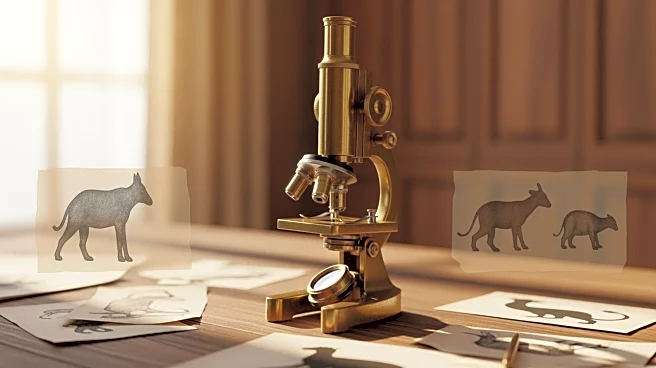




Comparative psychology, the scientific study of animal behavior and mental processes, has a rich history that traces back to ancient scholars and has evolved significantly over the centuries. This field focuses on understanding the similarities and differences in behavior across species, aiming to uncover the evolutionary and developmental aspects of behavior. From its early beginnings to its current state, comparative psychology has undergone numerous
transformations, influenced by various scientific discoveries and cultural shifts.
Early Beginnings and Influences
The roots of comparative psychology can be traced back to the works of early scholars such as al-Jahiz and Ibn al-Haytham, who explored animal behavior and communication. Al-Jahiz wrote about the social organization of animals like ants, while Ibn al-Haytham studied the effects of music on animal behavior, demonstrating how melodies could influence the pace of camels and other animals. These early contributions laid the groundwork for understanding animal behavior in relation to external stimuli.
In the 19th century, Charles Darwin's theory of evolution profoundly impacted the field, suggesting that human psychological traits could be understood through evolutionary principles. This led to the anecdotal movement, spearheaded by George Romanes, who aimed to demonstrate that animals possessed rudimentary human-like minds. Although Romanes' work faced criticism for its reliance on anecdotal evidence and anthropomorphism, it marked a significant step in the development of comparative psychology.
The Rise of Experimental Methods
The late 19th and early 20th centuries saw the emergence of experimental methods in comparative psychology. Researchers like Douglas Spalding and Jacques Loeb emphasized the importance of objective studies, focusing on instinct, imprinting, and learning processes in animals. Sir John Lubbock introduced the use of mazes and puzzles to study animal learning, while Conwy Lloyd Morgan advocated for a more disciplined approach to studying animal behavior.
Despite these advancements, the field faced challenges in the mid-20th century, as it became narrowly focused on studying white lab rats and pigeons, primarily in the context of learning in mazes. This limited scope was criticized by Frank Beach, who called for a broader exploration of animal behavior across species.
Modern Developments and Challenges
In recent decades, comparative psychology has expanded its focus, influenced by the rise of ethology and behavioral ecology. Ethologists have studied a wide range of species and behaviors, leading to a more comprehensive understanding of animal behavior. However, comparative psychology in the United States has struggled to maintain its prominence, overshadowed by the success of ethology.
Today, the field continues to grapple with questions about the relative intelligence of different species and the challenges of anthropomorphism in defining intelligence. Despite these obstacles, comparative psychology remains a vital area of study, contributing to our understanding of the complex interplay between genetics, environment, and behavior across species.