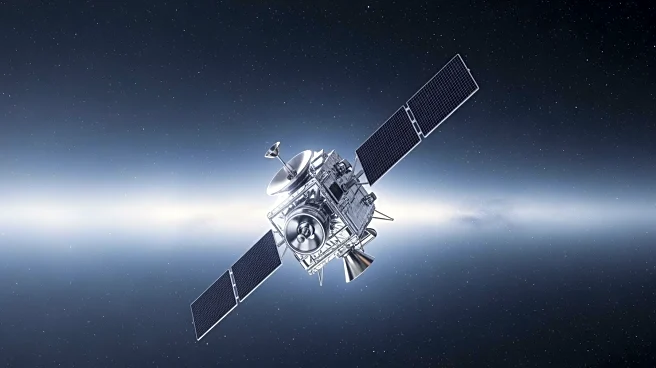




In 1958, Explorer 3 became a significant milestone in the field of space science. As part of the United States' Explorer program, this satellite played a crucial role in advancing our understanding of the Earth's radiation environment. This article explores the scientific achievements of Explorer 3, focusing on its contributions to the discovery of the Van Allen radiation belts and its impact on future space missions.
Discovering the Van Allen Belts
Explorer 3 was equipped with instruments
designed to study cosmic rays and micrometeorites. One of its primary objectives was to continue the experiments initiated by Explorer 1, which had detected unexpected radiation levels in space. Explorer 3's instruments, including a Geiger-Müller tube, provided more comprehensive data on the flux of high-energy charged particles.
The satellite's findings confirmed the existence of the Van Allen radiation belts, regions of charged particles trapped by the Earth's magnetic field. This discovery was groundbreaking, as it revealed a previously unknown aspect of the Earth's space environment. The data collected by Explorer 3 helped scientists understand the behavior of these particles and their potential impact on satellites and human space travel.
Advancing Space Science
The success of Explorer 3 marked a significant advancement in space science. The satellite's ability to provide a complete radiation history for each orbit, thanks to its onboard tape recorder, allowed for a more detailed analysis of the Earth's radiation environment. This capability was crucial for understanding the dynamics of the Van Allen belts and their interaction with solar and cosmic radiation.
Explorer 3's mission also contributed to the study of micrometeorites, providing valuable data on their distribution and impact on spacecraft. This information was essential for the design and protection of future satellites and space missions. The satellite's findings laid the groundwork for further exploration of the Earth's magnetosphere and the development of technologies to mitigate the effects of radiation in space.
Legacy and Influence
The achievements of Explorer 3 had a lasting impact on the field of space science. Its confirmation of the Van Allen belts was a major milestone that influenced the design and planning of subsequent space missions. The data collected by Explorer 3 continues to be a valuable resource for scientists studying the Earth's radiation environment and its effects on space exploration.
Explorer 3's legacy is a testament to the importance of early satellite missions in advancing our understanding of space. Its contributions to the discovery of the Van Allen belts and the study of cosmic rays and micrometeorites have paved the way for more sophisticated satellites and deeper exploration of our solar system.