

Soap bubbles are a fascinating phenomenon that captivates both children and adults alike. These delicate spheres of soap and water are not just a source of entertainment; they also demonstrate intriguing principles of physics and chemistry. Understanding how soap bubbles form and behave can provide insight into the complex interactions between liquids and gases.
Formation and Structure
Soap bubbles are formed when a thin film of soap and water traps air inside, creating a hollow
sphere. This film is composed of soap molecules that have hydrophilic (water-attracting) heads and hydrophobic (water-repelling) tails. When soap is added to water, these molecules arrange themselves in a way that reduces surface tension, allowing the water to stretch and form a bubble. The soap film is flexible and can expand to accommodate the air inside, creating the spherical shape that is characteristic of bubbles.
The spherical shape of soap bubbles is due to the minimization of surface area. In physics, this is known as the principle of minimal surface area, where the bubble forms a shape that requires the least amount of energy to maintain. This is why bubbles are always round, as a sphere has the smallest surface area for a given volume.
Optical Properties
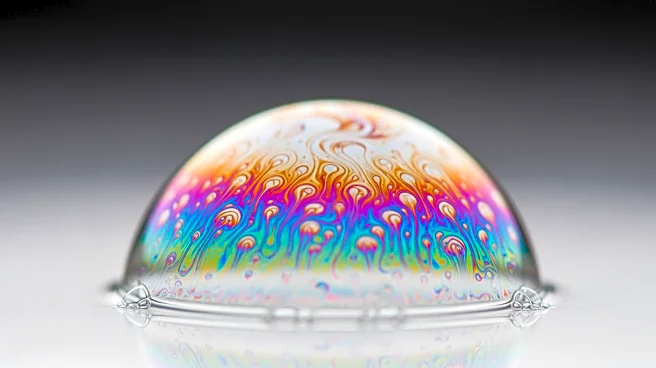
One of the most captivating features of soap bubbles is their iridescent surface. This iridescence is caused by the interference of light waves reflecting off the different layers of the soap film. As light hits the bubble, some of it is reflected off the outer surface, while some penetrates the film and is reflected off the inner surface. The varying thickness of the soap film causes different wavelengths of light to interfere with each other, producing the colorful patterns seen on the bubble's surface.
The colors change as the bubble moves and the film's thickness varies, creating a dynamic display that is both beautiful and scientifically interesting. This phenomenon is similar to the colors seen in oil slicks or the wings of certain insects, where thin-film interference plays a role.
Applications and Implications
Beyond their aesthetic appeal, soap bubbles have practical applications in science and technology. In medical imaging, for example, small encapsulated bubbles are used as contrast agents to enhance ultrasound images. These bubbles improve the visibility of blood vessels and tissues, aiding in the diagnosis of various conditions.
In the field of microfluidics, bubbles are used as actuators to control the movement of liquids in small-scale systems. This has implications for the development of lab-on-a-chip devices, which can perform complex analyses in a compact format. The study of bubbles also contributes to our understanding of fluid dynamics and the behavior of liquids and gases in different environments.
Soap bubbles, while simple in appearance, are a testament to the intricate interplay of physical and chemical forces. Their study not only enriches our understanding of basic scientific principles but also opens doors to innovative applications in various fields.