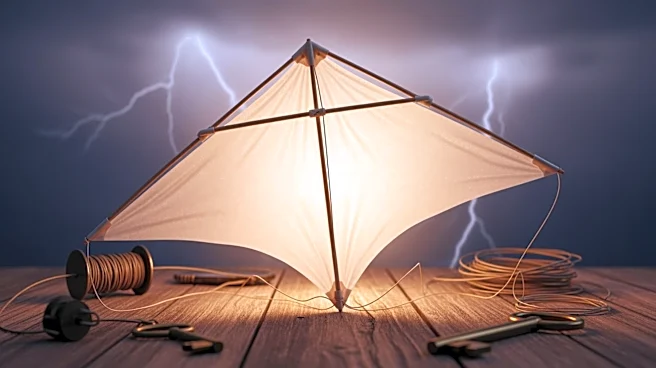









Benjamin Franklin's kite experiment in 1752 marked a pivotal moment in the study of electricity. By flying a kite during a thunderstorm, Franklin demonstrated that lightning is a form of electricity, fundamentally changing scientific understanding of the natural world. This experiment not only showcased Franklin's ingenuity but also laid the groundwork for future advancements in electrical science.
The Concept and Execution
Franklin's idea was to use a kite to raise a lightning
rod to a great height, allowing him to collect static electricity from the air. He described this experiment in a letter to the Pennsylvania Gazette, although he did not specify the exact circumstances under which he conducted it. The fullest account of the experiment was later provided by Joseph Priestley, who learned the details from Franklin himself. According to Priestley, Franklin conducted the experiment in June 1752 with the assistance of his son William. They used a hemp string attached to the kite, with a metallic key tied to the other end. This setup allowed Franklin to control the kite without directly touching the conducting string.
Contrary to popular belief, the kite was not struck by lightning. Instead, an electrical charge was induced on the kite by its proximity to an oppositely charged storm cloud. Franklin observed that loose threads of the string repelled each other, indicating that it had become electrically charged. He was able to transfer some of this charge to a Leyden jar by touching it to the key, and he also produced an electrical spark by approaching his hand to the key.
Scientific Impact and Legacy
Franklin's kite experiment was groundbreaking in proving the electrical nature of lightning. This discovery was crucial in advancing the understanding of electricity and its relationship with natural phenomena. The experiment demonstrated that electricity and lightning were manifestations of the same phenomenon, a concept that was not widely understood at the time.
The implications of Franklin's findings were profound, leading to the development of the lightning rod, a device that protects buildings from lightning strikes by safely conducting electrical charges into the ground. This invention significantly reduced the risk of fire and structural damage caused by lightning, showcasing the practical applications of Franklin's scientific work.
Franklin's Influence on Electrical Science
Franklin's contributions to the field of electricity extended beyond the kite experiment. His work influenced the reception of electrical science in Europe, where his experiments were widely discussed and respected. Priestley's treatise on electricity, which included Franklin's experiment, helped disseminate his findings and solidified his reputation as a leading figure in the study of electricity.
Franklin's innovative approach to scientific inquiry and his ability to communicate complex ideas effectively made him a key figure in the American Enlightenment. His kite experiment remains a symbol of scientific curiosity and the pursuit of knowledge, inspiring generations of scientists to explore the mysteries of the natural world.