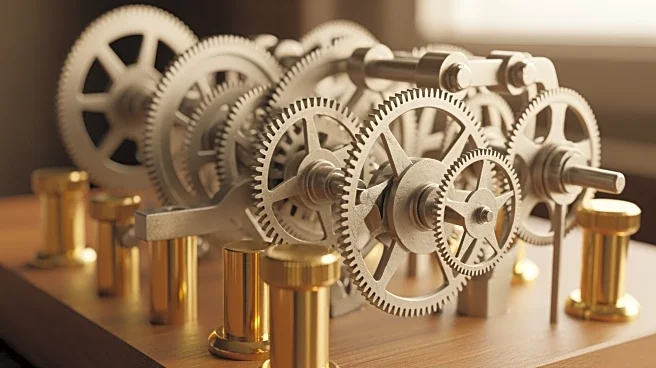




The construction of differential analyzers marked a significant milestone in the history of computing, and one of the intriguing aspects of their development was the use of Meccano parts. Meccano, a popular construction toy, played a crucial role in making these complex machines more accessible and affordable, demonstrating the innovative spirit of the engineers involved.
Meccano's Contribution to Early Designs
In 1934, Douglas Hartree and Arthur Porter at Manchester University built a model
differential analyzer using Meccano parts. This approach significantly reduced the cost of construction, making it possible to create a machine that was "accurate enough for the solution of many scientific problems." The use of Meccano parts was not only a practical solution but also a testament to the creativity and resourcefulness of the engineers.
The Manchester model was a proof-of-concept that demonstrated the feasibility of using readily available materials to construct complex computing devices. This innovation paved the way for further developments in mechanical computation, showing that sophisticated machines could be built without the need for expensive, custom-made components.
Wartime Modifications and Applications
During World War II, the differential analyzer built with Meccano parts at Cambridge University was modified for improved reliability and enhanced capability. These modifications were documented in a memorandum for the British military's Armament Research Department, highlighting the machine's wartime applications, including research on heat flow, explosive detonations, and simulations of transmission lines.
The adaptability of the Meccano-based differential analyzers made them valuable tools in wartime research, providing insights into various scientific and engineering challenges. The ability to modify and enhance these machines using simple parts demonstrated their versatility and the ingenuity of the engineers who worked on them.
Legacy and Continued Interest
The use of Meccano in differential analyzers is a fascinating chapter in the history of computing, illustrating how creativity and resourcefulness can overcome technical and financial barriers. It has been estimated that about 15 Meccano model differential analyzers were built for serious work by scientists and researchers around the world.
Today, these machines are celebrated for their historical significance and the innovative spirit they represent. The differential analyzer built at Cambridge University is now part of the Museum of Transport and Technology (MOTAT) collection in Auckland, New Zealand, serving as a reminder of the pioneering efforts that shaped the development of computing technology.