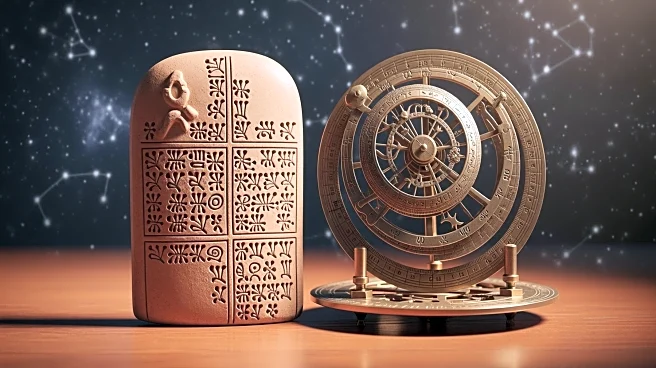




In ancient times, the night sky was a source of wonder and mystery. Among the countless stars, certain celestial bodies stood out due to their unique movements. These were the classical planets, visible to the naked eye, and they played a significant role in the development of early astronomy and astrology. The classical planets include the Sun, Moon, Mercury, Venus, Mars, Jupiter, and Saturn. These celestial wanderers were not only important for
scientific observation but also held deep cultural and religious significance.
The Origins of Classical Planets
The concept of classical planets dates back to ancient civilizations, where they were observed and recorded by astronomers such as the Babylonians and Greeks. The term "planet" itself comes from the Greek word "planētēs," meaning "wanderer," reflecting the planets' movement across the sky relative to the fixed stars. Greek astronomers like Ptolemy and Geminus documented these celestial bodies, laying the groundwork for future astronomical studies. The Babylonians were among the first to recognize the seven classical planets, associating each with a deity and incorporating them into their astrological systems.
In ancient Greece, the planets were seen as divine entities, each associated with a god or goddess. This connection between the planets and deities was not unique to Greece; many cultures, including the Romans and Egyptians, made similar associations. The planets' movements were believed to influence human affairs, a belief that persisted into the development of astrology.
The Role of Classical Planets in Astrology
Astrology, the study of celestial influences on human life, heavily relied on the classical planets. Each planet was thought to govern specific aspects of life and personality. For example, Mars was associated with war and aggression, while Venus was linked to love and beauty. The positions of these planets at the time of a person's birth were believed to shape their destiny and character.
The classical planets also played a crucial role in the development of the astrological zodiac. The zodiac is divided into twelve signs, each associated with a planet. This system allowed astrologers to interpret the influence of the planets on individuals and events. Despite the rise of modern science, astrology remains popular, with many people still consulting their horoscopes based on the positions of the classical planets.
The Legacy of Classical Planets
The study of classical planets laid the foundation for modern astronomy. The observations and theories developed by ancient astronomers were crucial in advancing our understanding of the solar system. The transition from a geocentric to a heliocentric model of the universe was a significant milestone, influenced by the study of these planets.
Today, the classical planets continue to captivate our imagination. They are a testament to humanity's enduring fascination with the cosmos and our quest to understand our place in the universe. The legacy of the classical planets is evident in both scientific inquiry and cultural traditions, highlighting their lasting impact on human history.