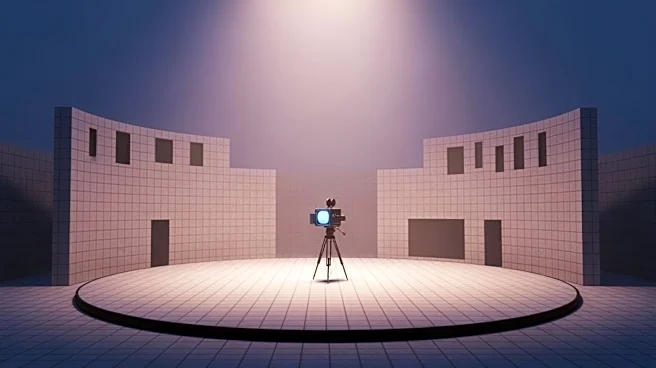








The Truman Show, a 1998 film directed by Peter Weir, delves into the intriguing themes of simulated reality and existentialism. Starring Jim Carrey as Truman Burbank, the film presents a world where Truman's life is broadcasted as a reality TV show without his knowledge. This unique premise allows the film to explore deep philosophical questions about reality, identity, and freedom.
The World of Seahaven
In The Truman Show, Truman Burbank lives in Seahaven, a seemingly
idyllic town that is, in fact, a massive set constructed under a dome. This artificial environment is complete with a fake sun, sky, and sea, all designed to keep Truman unaware of the truth. The town is populated by actors who play roles in Truman's life, from his wife to his best friend, all orchestrated by the show's creator, Christof.
The film uses this setting to explore the concept of a controlled reality. Truman's every move is monitored by thousands of hidden cameras, and his life is manipulated to maintain the illusion. This raises questions about the nature of reality and whether our perceptions can be trusted. The film suggests that reality is not just what we see but also what we are led to believe.
Truman's Awakening
As the film progresses, Truman begins to notice inconsistencies in his world. A stage light falls from the sky, and he overhears a radio broadcast describing his actions. These events spark Truman's curiosity and lead him to question the authenticity of his life. His journey of self-discovery is a central theme of the film, highlighting the human desire for truth and freedom.
Truman's awakening is also marked by his memories of Sylvia, a woman he fell in love with despite the show's script. Sylvia's removal from the show and her subsequent activism to free Truman symbolize the struggle against a controlled existence. Truman's quest to find Sylvia and escape Seahaven represents the universal search for meaning and autonomy.
The Philosophical Implications
The Truman Show raises profound philosophical questions about free will and determinism. Christof, the show's creator, acts as a god-like figure, controlling every aspect of Truman's life. This dynamic explores the tension between predestination and the human capacity for choice.
The film also touches on existential themes, questioning the purpose of life and the nature of reality. Truman's decision to leave Seahaven and enter the unknown world beyond the dome is a powerful statement about the courage to seek one's own path. It challenges viewers to consider their own lives and the extent to which they are influenced by external forces.
In conclusion, The Truman Show is more than just a film; it is a thought-provoking exploration of reality, identity, and freedom. Through its unique narrative and compelling themes, it invites audiences to reflect on their own perceptions and the world around them.