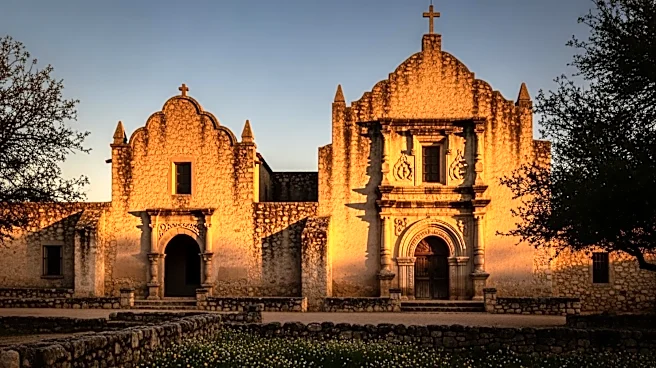







The Alamo, located in San Antonio, Texas, has undergone a remarkable transformation over the centuries. Originally established as a Spanish mission, it later became a military fortress and the site of a pivotal battle during the Texas Revolution. Today, the Alamo stands as a museum and a major tourist attraction, drawing millions of visitors each year. This journey from mission to museum reflects the site's enduring historical and cultural significance.
The Alamo's Early Days as a Mission
The Alamo began as the Misión San Antonio de Valero, one of several missions established by Spanish Catholic missionaries in the early 18th century. These missions aimed to convert local Native American tribes to Christianity and provide them with protection from rival tribes. The mission complex expanded over the years, becoming largely self-sufficient with its own farmland and livestock.
By 1744, the mission housed over 300 Indian converts and produced significant amounts of corn, beans, and cotton. However, the mission's influence waned over time, and by 1793, it was secularized and abandoned as a religious institution. The site then transitioned to a military role, eventually becoming a key location in the Texas Revolution.
The Alamo as a Military Fortress
After its secularization, the Alamo was repurposed as a military fortress. It played a significant role during the Texas Revolution, particularly during the famous Battle of the Alamo in 1836. Despite being heavily outnumbered, the Texian defenders, including notable figures like James Bowie and Davy Crockett, held out against the Mexican Army led by General Antonio López de Santa Anna.
The fall of the Alamo became a rallying cry for Texian forces, inspiring them to continue their fight for independence. The phrase "Remember the Alamo" became synonymous with the struggle for Texan independence and remains a powerful symbol of resistance and sacrifice to this day.
The Alamo's Transformation into a Museum
In the years following the Texas Revolution, the Alamo fell into disrepair. However, efforts to preserve the site began in the late 19th century, led by the Daughters of the Republic of Texas (DRT). Their dedication ensured that the Alamo would be preserved for future generations.
Today, the Alamo is a museum that offers visitors a glimpse into its storied past. Exhibits showcase artifacts from the Texas Revolution and the mission's earlier days, providing a comprehensive look at the site's history. The Alamo's transformation from a mission to a museum highlights its enduring significance as a symbol of Texas history and a testament to the resilience of those who fought for independence.