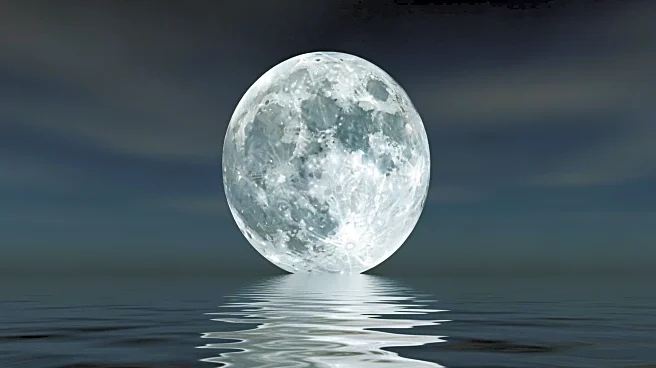




The term 'supermoon' has captured the imagination of skywatchers and astrologers alike, but what exactly does it mean? A supermoon occurs when a full or new moon coincides with the moon's closest approach to Earth, known as perigee. This event results in a moon that appears larger and brighter than usual. While the term originates from astrology, it has gained popularity in astronomical discussions, despite lacking a precise scientific definition.
The Astronomical Perspective
From an astronomical standpoint, a supermoon is technically referred to as a perigee syzygy. This term describes the alignment of the Earth, Moon, and Sun when the Moon is at or near its closest point to Earth. The Moon's orbit around Earth is elliptical, meaning its distance from Earth varies. At perigee, the Moon is about 363,300 kilometers away, compared to 405,507 kilometers at apogee, its farthest point. This difference in distance results in a supermoon appearing up to 14% larger in diameter and 30% brighter than a micromoon, which occurs at apogee.
The concept of supermoons was popularized by astrologer Richard Nolle in 1979, who defined it as a new or full moon occurring within 90% of its closest approach to Earth. Despite its astrological roots, the term has been embraced by the public and media, often leading to increased interest in lunar events.
Astrological Origins and Popularity
The term 'supermoon' was coined by Richard Nolle, an astrologer, who defined it in a 1979 issue of Dell Horoscope magazine. Nolle's definition was based on the Moon's proximity to Earth during its orbit, specifically when it is within 90% of its closest approach. This definition, while arbitrary, has resonated with the public, leading to widespread use of the term in both astrological and astronomical contexts.
Astrologically, supermoons are believed to influence human emotions and behaviors, although scientific evidence supporting these claims is lacking. Nonetheless, the term has become a staple in popular culture, often associated with heightened emotional states and significant events.
Supermoons and Natural Phenomena
There have been claims that supermoons can trigger natural disasters such as earthquakes and volcanic eruptions due to increased gravitational forces. However, scientific studies have found no direct link between supermoons and such events. While the Moon does affect oceanic tides, the gravitational pull during a supermoon is not significantly stronger than during a regular full moon.
Despite the lack of scientific evidence, supermoons continue to captivate the public's imagination, often leading to increased interest in lunar observations. The phenomenon provides an opportunity for people to connect with the natural world and appreciate the beauty of the night sky.