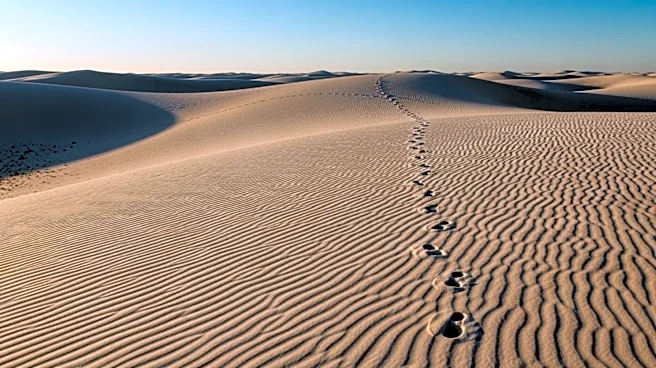






White Sands National Park is not only a geological wonder but also a site of significant human history. The discovery of ancient human footprints at the park has provided valuable insights into the lives of early inhabitants of the Americas. These footprints, found in the Tularosa Basin, offer a glimpse into the past and challenge previous theories about human migration to the continent.
Discovery and Significance of the Footprints
In 2009, a set of ancient human footprints was discovered at
White Sands National Park. These footprints, preserved in the gypsum sand, were radiocarbon dated in 2021 to be between 21,000 and 23,000 years old. If these dates are accurate, they represent some of the oldest evidence of human presence in the Americas, predating previous estimates of human migration by several thousand years.
The footprints were found along the shores of a now-dry lake, Lake Otero, which existed during the last ice age. The area, once lush with grasslands and vegetation, provided a suitable habitat for both humans and animals. The discovery of these footprints has sparked scientific debate and interest, as they offer new perspectives on the timeline of human settlement in the Americas.
Insights into Ancient Human Life
The footprints at White Sands National Park provide a unique window into the lives of the people who once inhabited the area. The prints show good anatomical definition, with visible heel impressions and toe pads, indicating that the individuals who made them were likely barefoot. The majority of the footprints belong to teenagers and children, suggesting that they were involved in daily tasks such as fetching and carrying.
One set of footprints appears to show a human tracking a giant sloth, providing evidence of hunting activities. Another set suggests a journey made by an adult with a young child, indicating the presence of family groups in the area. These findings offer a glimpse into the social structure and daily activities of the ancient inhabitants.
The Ongoing Debate and Research
The dating of the footprints has been a topic of controversy, with some researchers questioning the accuracy of the radiocarbon dates. The original dates were based on seeds found in the sediment layers, but concerns have been raised about the potential for older carbon to skew the results. Despite these debates, further studies have supported the initial findings, suggesting that the footprints are indeed among the oldest in the Americas.
The discovery of the footprints at White Sands National Park continues to be a subject of ongoing research and interest. As scientists work to unravel the mysteries of these ancient tracks, they provide valuable insights into the history of human migration and adaptation. The park remains a vital site for understanding the interaction between humans and the environment during the ice age.