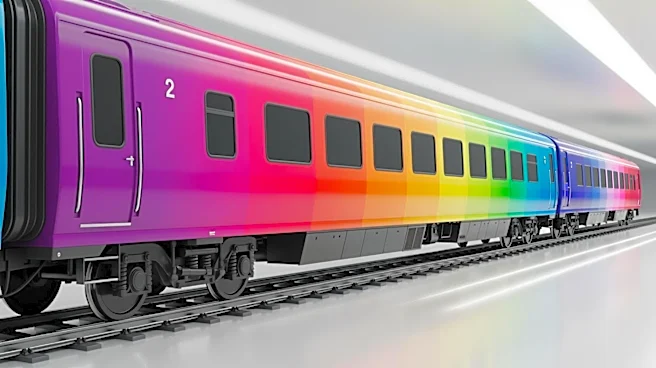






The transition from the Rainbow Era to the Phase paint schemes marked a significant evolution in Amtrak's visual identity. Introduced in 1972, the Phase schemes were designed to create a unified and recognizable brand for Amtrak, moving away from the colorful patchwork of liveries inherited from predecessor railroads. This journey towards unity was not only about aesthetics but also about establishing Amtrak's presence as a national passenger railroad.
The Birth of the Phase Schemes
Amtrak's Phase paint schemes were first introduced in 1972, just a year after the company began operations. The goal was to replace the mismatched liveries of the Rainbow Era with a cohesive and patriotic visual identity. The Phase schemes primarily featured geometric arrangements of red, white, and blue, the national colors of the United States. This choice of colors was a deliberate nod to Amtrak's role as a national service provider.
The Phase schemes were sequentially numbered using Roman numerals, a nomenclature that began with model railroaders and was later officially adopted by Amtrak. The first of these, Phase I, set the standard for the new visual identity. Locomotives were painted light gray with a black roof, featuring the Amtrak "Pointless Arrow" chevron logo on the side and a red nose, earning the nickname "Bloody Nose."
Evolution of the Phase Schemes
As Amtrak continued to grow, so did its paint schemes. Phase II was introduced in late 1974, coinciding with the arrival of new GE E60 locomotives. This phase saw the removal of the red nose and chevron logo, replaced by the same stripes found on passenger cars, which wrapped around the nose of the locomotive. The evolution continued with Phase III in 1976, which introduced equal-width red, white, and blue stripes, providing a more balanced and reflective design.
Each subsequent phase brought refinements and adaptations to meet the changing needs of Amtrak's fleet. Phase IV, introduced in 1993, marked a departure from the traditional red, white, and blue style, featuring two thin red stripes and a thick dark blue stripe. This phase was initially applied to the newer Superliner II cars and later extended to locomotives.
Significance of a Unified Identity
The development of the Phase paint schemes was more than just a visual overhaul; it was a strategic move to build Amtrak's brand as a unified passenger railroad. By adopting a consistent and recognizable livery, Amtrak aimed to foster a sense of trust and reliability among passengers. The patriotic colors reinforced Amtrak's identity as a national service, while the geometric designs provided a modern and professional appearance.
The Phase schemes also addressed practical challenges, such as maintenance and recognition. A unified livery made it easier for mechanics to work on the equipment, as they no longer had to contend with the diverse designs of the Rainbow Era. Additionally, the consistent branding helped passengers easily identify Amtrak trains, enhancing the overall travel experience.
In conclusion, the transition from the Rainbow Era to the Phase paint schemes was a pivotal moment in Amtrak's history. It marked the company's commitment to establishing a cohesive and recognizable brand, setting the stage for its continued growth and success as a national passenger railroad.