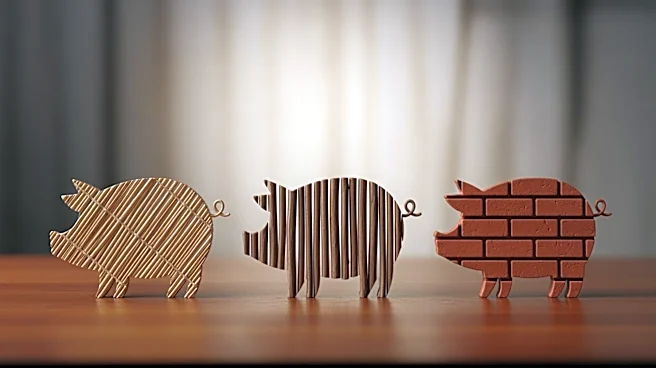







The fable of "The Three Little Pigs" is a timeless story that has been passed down through generations, captivating audiences with its simple yet profound narrative. Originating in the 1840s, the tale has undergone numerous adaptations and interpretations, each adding a unique twist to the classic story. This article delves into the historical development of "The Three Little Pigs," tracing its journey from early versions to its most well-known form
today.
Early Versions and Origins
The earliest known printed version of "The Three Little Pigs" dates back to the 1840s, but the story is believed to be much older. The initial version of the tale took place in Dartmoor, Devon, England, and featured three pixies and a fox instead of pigs and a wolf. This early iteration set the stage for the story's evolution, as it was later adapted to include the now-iconic pigs and wolf.
In 1886, James Halliwell-Phillipps published a version of the story in the fifth edition of his "Nursery Rhymes of England." This version introduced the famous phrases "not by the hair of my chiny chin chin" and "I'll huff, and I'll puff, and I'll blow your house in," which have since become synonymous with the tale. Halliwell-Phillipps's version laid the groundwork for future adaptations, solidifying the story's place in Western culture.
Joseph Jacobs and the Popularization
The story of "The Three Little Pigs" reached new heights of popularity with its inclusion in Joseph Jacobs's "English Fairy Tales," first published in 1890. Jacobs credited Halliwell-Phillipps as his source, and his version is often considered the definitive telling of the tale. In this rendition, the three pigs each build houses of different materials—straw, sticks, and bricks—only for the first two houses to be blown down by the Big Bad Wolf.
Jacobs's version emphasized the moral of the story: the importance of hard work and preparation. The third pig, who builds his house out of bricks, ultimately outsmarts the wolf, showcasing the value of diligence and foresight. This moral lesson resonated with audiences and contributed to the story's enduring appeal.
Modern Adaptations and Variations
Over the years, "The Three Little Pigs" has been adapted and reimagined in countless ways. Some versions portray the wolf as a kind character, while others introduce new elements or characters to the story. For example, in some adaptations, the first two pigs escape to their brother's brick house, altering the original narrative.
The tale has also been incorporated into various media, including literature, film, and television. Notable adaptations include Joel Chandler Harris's "Uncle Remus" stories, which replaced the pigs with Br'er Rabbit, and Andrew Lang's "The Green Fairy Book," which introduced new character names and settings. These adaptations highlight the story's versatility and its ability to be molded to fit different cultural contexts.
In conclusion, "The Three Little Pigs" has evolved significantly since its early origins, with each adaptation adding new layers to the classic fable. Its enduring popularity is a testament to the story's universal themes and its ability to captivate audiences across generations.