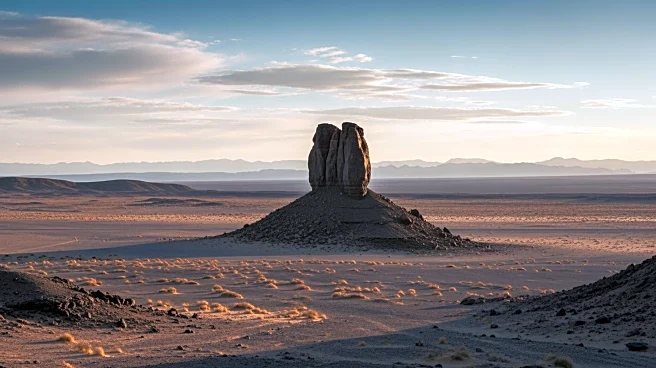




The Black Rock Desert in northwest Nevada is not only a geographical marvel but also a site rich in history. From ancient human settlements to 19th-century emigrant trails, this desert has been a witness to significant historical events and human activities. Its vast expanse and unique features have made it a landmark for explorers, settlers, and adventurers throughout the centuries.
Early Human Presence and Native American Heritage
Human presence in the Black Rock Desert dates back approximately
10,000 years. The area was initially inhabited by Great Basin tribes, and around 1300 CE, the Paiute people settled in the region. The desert's namesake, a large black rock formation, served as a crucial landmark for the Paiute and later for emigrants crossing the area. This conical outcrop, composed of interbedded Permian marine limestone and volcanic rocks, was a vital guidepost in the vast desert landscape.
The base of this rock formation features a large hot spring and grassy meadow, which were essential resources for those traversing the desert. These natural features provided much-needed respite and sustenance for travelers heading to California and Oregon.
Emigrant Trails and the Gold Rush
In 1843, John Frémont and his party became the first white men to cross the Black Rock Desert. His trail was later used by over half of the 22,000 gold seekers heading to California after 1849. The desert was a critical segment of the Emigrant Trails, offering a route through the challenging terrain of the Great Basin.
The Applegate-Lassen Cutoff, a part of the California Trail, passed through the desert, although it was an arduous route that took emigrants hundreds of miles away from their intended destinations. Despite its challenges, the trail was a vital passage for those seeking fortune in the gold fields of California.
Modern Developments and Conservation Efforts
The Black Rock Desert has continued to play a role in modern history. In the late 19th century, Hardin City, a short-lived silver mill town, was established in the area, although it is now a ghost town. The desert has also been a site for various land speed records and rocketry experiments, taking advantage of its flat, expansive playa.
In 2000, the Black Rock Desert was designated as part of the National Conservation Area, managed by the Bureau of Land Management. This designation helps preserve the desert's historical trails and natural landmarks, ensuring that its rich history and unique environment are protected for future generations to explore and appreciate.