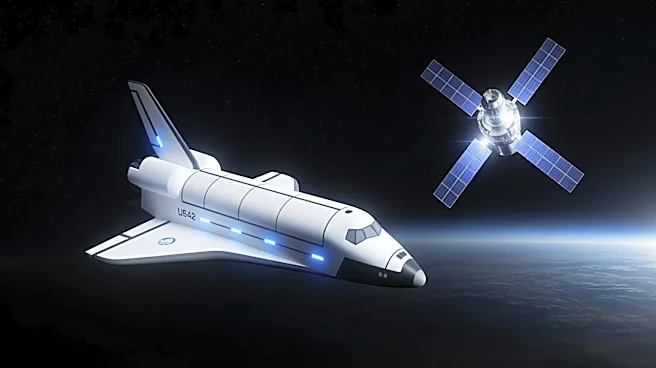




STS-41-C was a landmark mission in NASA's Space Shuttle program, marking the eleventh flight of the Space Shuttle and the fifth for Challenger. Launched on April 6, 1984, this mission was notable for its ambitious objectives, including the repair of the Solar Maximum Mission satellite and the deployment of the Long Duration Exposure Facility. The mission's success demonstrated the versatility and capability of the Space Shuttle as a tool for both
scientific advancement and satellite maintenance.
The Launch and Objectives
The STS-41-C mission began with a launch from Kennedy Space Center on April 6, 1984. This mission was unique as it marked the first time a Space Shuttle used a direct ascent trajectory, reaching its orbit with minimal engine burns. The primary objectives were to capture and repair the malfunctioning Solar Maximum Mission satellite, known as Solar Max, and to deploy the Long Duration Exposure Facility (LDEF).
The LDEF was a passive, retrievable experimental apparatus designed to carry 57 scientific experiments contributed by researchers from eight countries. It was successfully deployed into orbit on the second day of the mission. The retrieval of LDEF was initially planned for 1985 but was delayed until 1990 due to the Challenger disaster.
Challenges and Solutions
Capturing and repairing the Solar Max satellite presented significant challenges. On the third day of the mission, astronauts George Nelson and James van Hoften attempted to capture the satellite using a Manned Maneuvering Unit (MMU) and a special tool called the Trunnion Pin Acquisition Device (TPAD). However, initial attempts to secure the satellite failed, causing it to tumble.
Despite these difficulties, the mission team persevered. The Goddard Space Flight Center's Payload Operations Control Center managed to stabilize the satellite's tumbling by sending commands to its magnetorquers. This allowed the crew to successfully capture Solar Max using the Remote Manipulator System (RMS) and secure it in the payload bay for repairs.
Successful Repairs and Legacy
Once Solar Max was secured, Nelson and van Hoften conducted two spacewalks to repair the satellite. They replaced its attitude control mechanism and the main electronics system of the coronagraph instrument. These repairs were successful, and Solar Max was redeployed into orbit, resuming full operation after a 30-day checkout period.
The STS-41-C mission concluded with a landing at Edwards Air Force Base on April 13, 1984, after completing 108 orbits. This mission not only showcased the Space Shuttle's ability to perform complex satellite repairs but also highlighted the importance of international collaboration in space research. The success of STS-41-C paved the way for future missions involving satellite maintenance and repair, solidifying the Space Shuttle's role as a versatile and essential tool in space exploration.