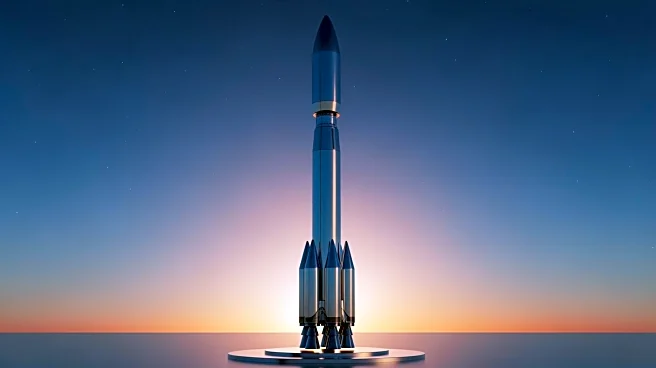

The Saturn I rocket marked a significant milestone in the United States' space exploration efforts as the first medium lift launch vehicle. Developed to meet the demands of launching heavier payloads into
low Earth orbit, the Saturn I played a crucial role in the early stages of the Apollo program. This article delves into the origins and development of the Saturn I, highlighting its design and the challenges faced during its creation.
Origins of the Saturn I
The Saturn I project began as a response to a Department of Defense requirement for a heavy-lift vehicle capable of orbiting new classes of satellites. The U.S. Army Ballistic Missile Agency, led by Wernher von Braun, initiated studies in 1957 to address this need. They calculated that a rocket with a thrust of about 1.5 million pound-force was necessary to meet the performance requirements. At the time, existing U.S. launchers could not meet these demands, prompting the development of a new vehicle.
The initial design of the Saturn I involved clustering existing rocket tanks and engines to create a more powerful booster. This approach allowed the use of existing manufacturing facilities and tooling, speeding up the development process. The design featured a central tank derived from the Jupiter rocket, surrounded by eight tanks similar to the Redstone stage. This configuration led to the nickname "Cluster's Last Stand," a play on the Battle of the Little Bighorn.
Design and Development Challenges
The development of the Saturn I faced several challenges, including the need for a reliable engine configuration. The original plan to use four E-1 engines was replaced with eight H-1 engines, a decision that saved time and money. The H-1 engines were a minor upgrade to the S-3D engine used on Thor and Jupiter missiles, providing the necessary thrust for the first stage.
Another challenge was the selection of upper stages. The Saturn I's second stage, the S-IV, was powered by six RL10 engines burning liquid hydrogen. This stage was crucial for achieving the desired payload capacity. The development of the S-IV stage involved overcoming technical hurdles related to the use of liquid hydrogen, a relatively new propellant at the time.
Impact on the Apollo Program
The successful development and testing of the Saturn I paved the way for the Apollo program. It demonstrated the feasibility of liquid hydrogen-fueled rocket propulsion and provided valuable data for the design of future launch vehicles. The Saturn I's ability to launch the Pegasus satellites and verify the Apollo command and service module's aerodynamics during launch was instrumental in advancing the United States' space exploration capabilities.
In conclusion, the Saturn I rocket was a pioneering achievement in the history of space exploration. Its development showcased the ingenuity and determination of the engineers and scientists involved, setting the stage for the monumental achievements of the Apollo program.