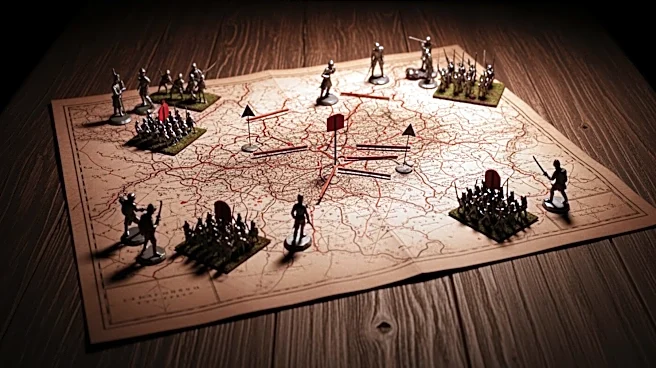







The Battle of Spotsylvania Court House, fought from May 8 to May 21, 1864, was a key engagement in the Overland Campaign of the American Civil War. This battle was marked by complex tactical maneuvers as Union forces, led by Ulysses S. Grant, sought to outflank and defeat the Confederate Army of Northern Virginia under Robert E. Lee. Despite the strategic intentions, the battle ended in a stalemate, highlighting the challenges of executing tactical plans
in the face of determined opposition.
Union Strategy and Initial Movements
Following the Battle of the Wilderness, Grant aimed to maneuver his forces southward to interpose between Lee's army and the Confederate capital of Richmond, Virginia. The capture of Spotsylvania Court House was central to this strategy, as it was a critical crossroads that could facilitate Union movements and disrupt Confederate supply lines.
However, the Confederate cavalry, followed by infantry, reached Spotsylvania Court House first, establishing defensive positions that complicated Union plans. The Confederate line included the "Mule Shoe" salient, which became a focal point for Union attacks. Grant's initial movements were aimed at breaking through these defenses, but the entrenched Confederate positions proved formidable.
The Battle's Tactical Engagements
On May 12, Grant launched a significant assault on the Mule Shoe, deploying several thousand men in an attempt to breach the Confederate line. The Union forces managed to capture part of the line, but Lee's reinforcements quickly counterattacked, leading to a day-long struggle marked by intense rifle fire and hand-to-hand combat.
The tactical engagements at the Mule Shoe and other parts of the battlefield demonstrated the challenges of overcoming well-fortified positions. The Confederate defenses, bolstered by reinforcements, held firm, preventing a decisive Union breakthrough. The battle's tactical complexity was further highlighted by the prolonged fighting at the "Bloody Angle," where close-quarters combat resulted in heavy casualties.
The Decision to Move Southward
After several days of intense fighting, Grant recognized that defeating Lee at Spotsylvania was not feasible. He decided to move his forces further south, continuing the Overland Campaign with the aim of maintaining pressure on the Confederate Army and ultimately capturing Richmond.
This decision underscored the importance of adaptability in military strategy, as Grant adjusted his plans in response to the tactical realities on the ground. The Battle of Spotsylvania Court House remains a significant example of the interplay between strategic objectives and tactical execution, where the complexities of warfare often dictate the course of action.