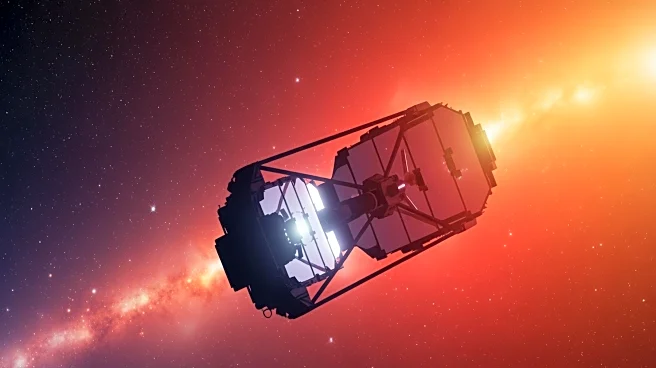



The James Webb Space Telescope (JWST) represents a significant leap forward in the field of infrared astronomy. Launched on December 25, 2021, it is the largest telescope ever placed in space, designed to observe the universe in unprecedented detail. Named after James E. Webb, a former NASA administrator, the telescope is a collaborative effort between NASA, the European Space Agency (ESA), and the Canadian Space Agency (CSA). Its advanced capabilities
allow it to explore the cosmos in ways that were previously impossible.
Advanced Design and Capabilities
The JWST is equipped with high-resolution and high-sensitivity instruments, making it capable of viewing objects that are too old, distant, or faint for the Hubble Space Telescope. Its primary mirror, made up of 18 hexagonal segments of gold-plated beryllium, has a diameter of 6.5 meters, significantly larger than Hubble's 2.4-meter mirror. This gives the JWST a light-collecting area about six times greater than that of Hubble, allowing it to detect objects up to 100 times fainter.
Unlike Hubble, which observes in the near ultraviolet, visible, and near-infrared spectra, the JWST is designed to observe a lower frequency range, from long-wavelength visible light through mid-infrared. This capability is crucial for studying high-redshift objects, which have their visible emissions shifted into the infrared. The telescope's design emphasizes the near to mid-infrared for several reasons, including the ability to see through dust clouds and detect colder objects like debris disks and planets.
Location and Orbit
The JWST operates in a halo orbit around the Sun-Earth L2 Lagrange point, approximately 1.5 million kilometers from Earth. This location allows the telescope to remain in a stable position relative to the Earth and Sun, minimizing the need for fuel-consuming maneuvers. The telescope's position also ensures that its sunshield can effectively block heat and light from the Sun, Earth, and Moon, keeping the instruments at the necessary cold temperatures for infrared observations.
The sunshield, a critical component of the JWST, consists of five layers of Kapton E film, each as thin as a human hair. This design provides an effective sun protection factor of 1,000,000, compared to suntan lotion with a range of 8 to 50. The sunshield's deployment was a complex process, requiring precise unfolding and tensioning to ensure its effectiveness.
Scientific Goals and Potential
The JWST's scientific goals are ambitious, aiming to observe the first stars and galaxies, study the formation of stars and planetary systems, and explore the potential for life on exoplanets. Its ability to detect faint infrared signals will allow scientists to look back in time to the early universe, providing insights into the formation and evolution of galaxies.
Additionally, the JWST will contribute to the study of exoplanets by analyzing their atmospheres for signs of habitability. By detecting molecules such as water, carbon dioxide, and methane, the telescope can help identify planets that may support life. The JWST's advanced capabilities make it a powerful tool for answering some of the most fundamental questions about the universe and our place in it.