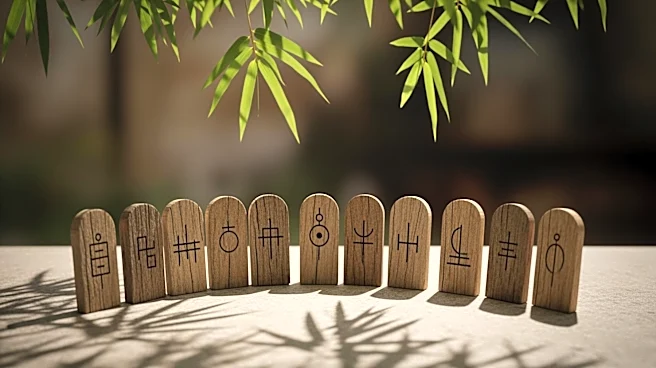






The Heavenly Stems, a system of ten ordinals, hold a significant place in Chinese culture and philosophy. Originating during the Shang dynasty, these stems have transcended their initial calendrical use to become symbols deeply embedded in Chinese cultural narratives. This article explores the cultural and symbolic impact of the Heavenly Stems, highlighting their role in rituals, mythology, and philosophical thought.
Role in Rituals and Mythology
In the Shang dynasty, the Heavenly
Stems were not only used to name the ten days of the week but also played a crucial role in rituals. The names of deceased family members often included a stem, indicating the day of the week on which sacrifices were made in their honor. This practice underscores the stems' importance in the religious and social life of the Shang people, where they served as a bridge between the living and the dead.
The stems are also linked to a mythological story involving ten suns that appeared in the sky, each representing a day in a ten-day cycle. This mythological connection highlights the stems' deep roots in Chinese cultural narratives, where they symbolize cosmic order and harmony. The integration of the stems into such stories reflects their significance beyond mere calendrical functions, embedding them in the cultural and spiritual fabric of ancient China.
Philosophical Connections
Following the Shang dynasty, the Heavenly Stems became associated with broader philosophical concepts such as yin and yang and the five elements (wuxing). These associations enriched the stems' symbolic meanings, linking them to cosmological and metaphysical ideas. The integration of the stems into these philosophical frameworks illustrates the dynamic nature of Chinese thought, where ancient systems were continually adapted and reinterpreted.
The stems' connection to yin and yang, for instance, reflects their role in representing balance and duality, fundamental concepts in Chinese philosophy. Similarly, their association with the five elements ties them to the natural world and its cyclical processes, emphasizing the interconnectedness of all things.
Contemporary Relevance
Today, the Heavenly Stems continue to be used as ordinals throughout East Asia, similar to how the alphabet is used in English. Despite their ancient origins, the stems have maintained their relevance, demonstrating the enduring legacy of ancient Chinese systems in contemporary culture. Their continued use in various cultural and astrological contexts highlights the adaptability and resilience of traditional Chinese practices.
In conclusion, the Heavenly Stems are more than just a calendrical tool; they are a symbol of cultural continuity and philosophical depth. Their integration into rituals, mythology, and philosophical thought underscores their significance in Chinese culture, where they continue to inspire and inform contemporary practices.