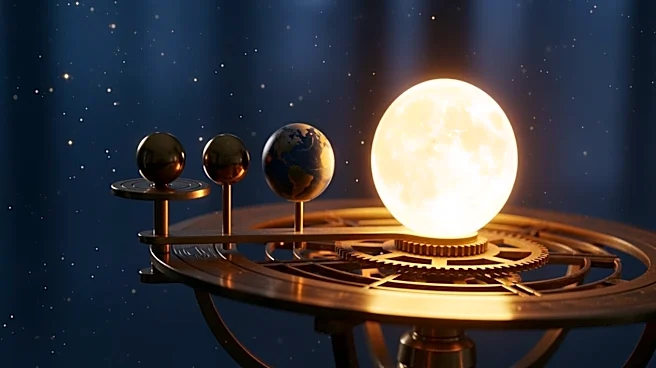






The Saros cycle is a fascinating astronomical phenomenon that plays a crucial role in predicting solar and lunar eclipses. This cycle, which spans 18 years, 11 days, and 8 hours, is a period after which the Earth, Moon, and Sun return to approximately the same relative geometry. This alignment results in nearly identical eclipses occurring at regular intervals. The Saros cycle is a testament to the intricate dance of celestial bodies and has been
a tool for astronomers for centuries.
The Mechanics of the Saros Cycle
The Saros cycle is based on the synchronization of three lunar periods: the synodic month, the draconic month, and the anomalistic month. The synodic month, lasting about 29.53 days, is the time it takes for the Moon to return to the same phase. The draconic month, approximately 27.21 days, is the time it takes for the Moon to return to the same node, which is the point where its orbit crosses the ecliptic plane. The anomalistic month, about 27.55 days, is the time it takes for the Moon to return to the same point in its elliptical orbit.
These three periods align almost perfectly every Saros cycle, allowing for the prediction of eclipses. When the Moon is new or full and near one of its nodes, an eclipse can occur. The Saros cycle ensures that after 18 years, 11 days, and 8 hours, the Earth, Moon, and Sun align in a similar configuration, resulting in a similar eclipse.
Historical Significance of the Saros Cycle
The concept of the Saros cycle dates back to ancient civilizations. The Chaldeans, a group of ancient astronomers in Babylon, were among the first to recognize this cycle. They used it to predict eclipses, a practice that was later adopted by Greek astronomers like Hipparchus and Ptolemy. The name "Saros" was introduced by Edmond Halley in 1686, who borrowed it from the Suda, a Byzantine lexicon.
The Saros cycle's ability to predict eclipses made it an invaluable tool for ancient astronomers. Eclipses were often seen as omens, and the ability to predict them gave astronomers a sense of control over these celestial events. This cycle has continued to be a cornerstone of eclipse prediction in modern astronomy.
The Saros Cycle in Modern Astronomy
Today, the Saros cycle remains a vital tool for astronomers. It allows for the prediction of both solar and lunar eclipses with remarkable accuracy. Each eclipse is part of a Saros series, which can last for over a thousand years and include dozens of eclipses. These series are numbered, and at any given time, multiple Saros series are active.
The Saros cycle's precision is a testament to the predictable nature of celestial mechanics. It highlights the interconnectedness of the Earth, Moon, and Sun and underscores the importance of understanding these relationships in the study of astronomy. As we continue to explore the cosmos, the Saros cycle remains a fundamental concept in our understanding of eclipses and the movements of celestial bodies.