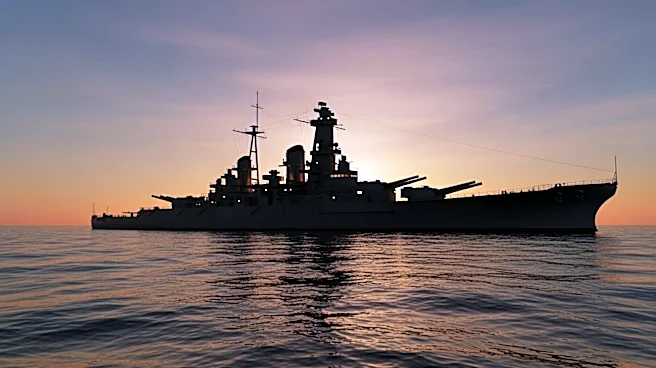






The USS New Mexico (BB-40) was a significant battleship in the United States Navy, serving from 1918 to 1946. As the lead ship of her class, she was the first to be named after the state of New Mexico. This article explores the historical timeline of the USS New Mexico, from her construction and early service to her role in World War II and eventual decommissioning.
Construction and Early Service
The keel of the USS New Mexico was laid down on October 14, 1915, at the New York Navy
Yard. She was launched on April 23, 1917, and commissioned on May 20, 1918. As the U.S. Navy's most advanced warship at the time, she was the first battleship to feature a turbo-electric transmission, allowing her to reach a maximum speed of 21 knots. Shortly after her commissioning, the USS New Mexico escorted the ship carrying President Woodrow Wilson to France for the Treaty of Versailles.
Following her initial duties, the USS New Mexico became the first flagship of the newly created United States Pacific Fleet. During the interwar period, she participated in numerous exercises with both the Pacific and Atlantic Fleets. The ship also served as a trial vessel for PID controllers, which were used for automated steering. Between March 1931 and January 1933, the USS New Mexico underwent a major modernization, which included significant upgrades to her armament and propulsion systems.
World War II Service
As World War II loomed, the USS New Mexico was initially involved in neutrality patrols in the Atlantic Ocean. However, after the attack on Pearl Harbor, she returned to the Pacific, where she played a crucial role in several key operations. The battleship participated in shore bombardments during operations at Attu and Kiska, Tarawa, the Marshall Islands, the Mariana and Palau islands, Leyte, Luzon, and Okinawa.
Throughout the war, the USS New Mexico was attacked by kamikazes on multiple occasions. Despite these attacks, she continued to provide vital support to Allied forces. Her service in the Pacific campaign earned her six battle stars. Notably, the USS New Mexico was present in Tokyo Bay for Japan's formal surrender on September 2, 1945, marking the end of World War II.
Decommissioning and Legacy
After the war, the USS New Mexico sailed back to the United States, arriving in Boston on October 17, 1945. She was decommissioned on July 19, 1946, and struck from the Naval Vessel Register on February 25, 1947. The battleship was sold for scrapping in November 1947, but her journey to the scrapyard was not without incident.
Attempts to bring the USS New Mexico to Newark, New Jersey, for dismantling were met with resistance from city officials. The situation, dubbed the "Battle of Newark Bay," was eventually resolved, allowing the ship to be scrapped by July 1948. Despite her dismantling, the legacy of the USS New Mexico lives on. Two of her ship's bells were donated to the state of New Mexico, where they remain as historical artifacts.
The USS New Mexico (BB-40) served as a testament to the technological advancements and strategic importance of battleships in the early 20th century. Her contributions during World War II and her role as a flagship in the Pacific Fleet highlight her significance in naval history.