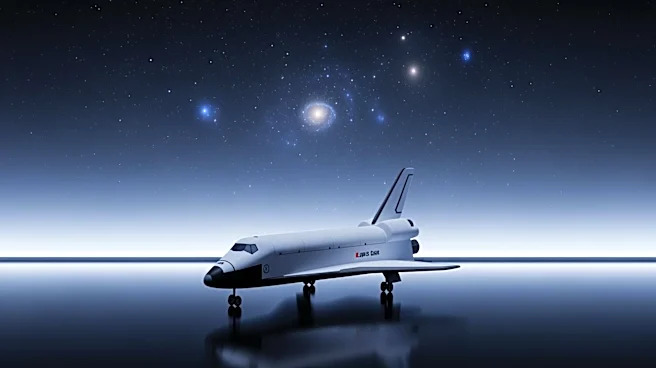

The STS-51-B mission marked a significant chapter in NASA's Space Shuttle program. Launched on April 29, 1985, aboard the Challenger, it was the 17th flight of the program and the seventh for the Challenger orbiter.
This mission was notable for its scientific contributions and the operational use of the European Space Agency's Spacelab module. Over the course of seven days, the crew conducted a series of experiments in microgravity, demonstrating the shuttle's capabilities for multidisciplinary research.
The Launch and Crew
STS-51-B's launch was initially delayed due to a launch processing failure, but it successfully lifted off from Kennedy Space Center on April 29, 1985. The mission was commanded by Robert F. Overmyer, with Frederick D. Gregory as the pilot. The crew also included mission specialists Don L. Lind, Norman E. Thagard, and William E. Thornton, along with payload specialists Lodewijk van den Berg and Taylor G. Wang. This diverse team worked in two 12-hour shifts to ensure continuous operation of the experiments aboard the shuttle.
The mission's insignia featured the Challenger with its payload doors open, symbolizing the onboard Spacelab 3. The insignia also paid homage to the Mercury Seven astronauts, with seven stars representing the crew members. The mission was a testament to international collaboration, with the European Space Agency's Spacelab playing a central role.
Scientific Achievements
STS-51-B was the second flight of the ESA's Spacelab pressurized module, and the first in a fully operational configuration. The mission successfully demonstrated Spacelab's capabilities for conducting multidisciplinary research in microgravity. The stable gravity gradient attitude of the orbiter allowed for delicate experiments in materials processing and fluid mechanics to proceed without interruption.
The mission carried 15 primary experiments, of which 14 were successfully performed. Notably, it included biological experiments involving two squirrel monkeys and 24 rats, marking the second time American astronauts flew live non-human mammals aboard the shuttle. The mission also deployed two Getaway Special experiments, NUSAT and GLOMR, although only NUSAT was successfully deployed.
Challenges and Legacy
Despite its successes, STS-51-B faced challenges. An experiment designed by Taylor Wang malfunctioned, but he was able to repair it, ensuring the mission's scientific objectives were met. The mission also highlighted potential safety concerns, as later investigations revealed issues with the shuttle's O-rings, similar to those that led to the Challenger disaster in 1986.
STS-51-B's contributions to space research and its demonstration of Spacelab's capabilities left a lasting impact on the Space Shuttle program. The mission's achievements in microgravity research paved the way for future scientific endeavors aboard the shuttle, reinforcing the importance of international collaboration in space exploration.