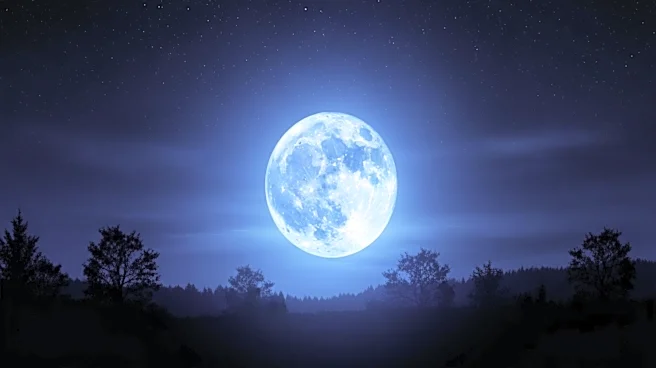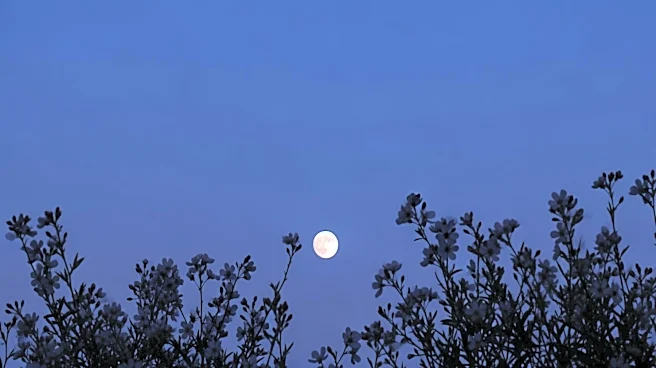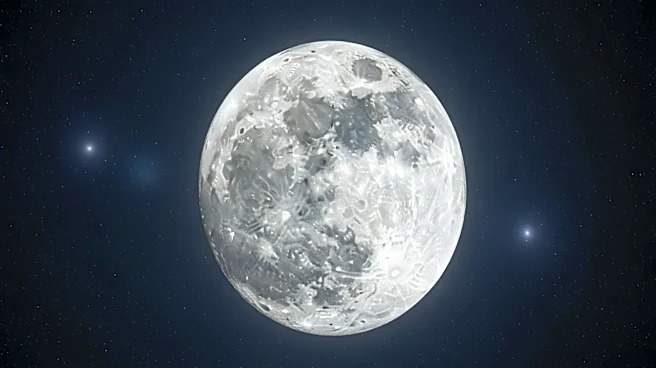


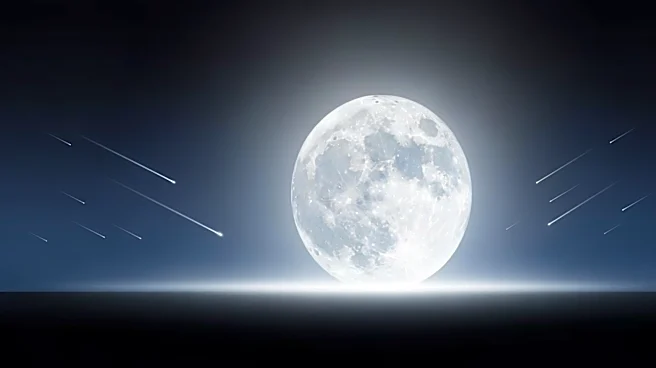
The full moon is a fascinating astronomical event that occurs when the Moon is fully illuminated from Earth's perspective. This phenomenon happens roughly once a month, when Earth is positioned between the Sun and the Moon. While the full moon is often thought of as a single night's event, its astronomical characteristics reveal a more complex and dynamic process.
The Full Moon's Orbital Dynamics
The full moon occurs when the ecliptic longitudes of the Sun and Moon differ by 180 degrees,
placing Earth directly between them. This alignment results in the lunar hemisphere facing Earth being completely sunlit, appearing as a circular disk. However, due to the Moon's orbit being inclined by 5.145 degrees from the ecliptic, the full moon is not always perfectly opposite the Sun.
This inclination means that a full moon is generally not perfectly full except during a lunar eclipse, when the Moon crosses the ecliptic at opposition from the Sun. Lunar eclipses occur when the Moon moves into Earth's shadow, causing it to appear reddish due to the scattering of blue wavelengths and the refraction of sunlight through Earth's atmosphere.
Variations in Full Moon Timing
The time interval between a full moon and the next repetition of the same phase, known as a synodic month, averages about 29.53 days. However, irregularities in the Moon's orbit can cause the new and full moons to fall up to thirteen hours either side of their mean. Additionally, discrepancies arise depending on the time zone and whether the calendar day begins in the evening or at midnight.
For any given location, about half of the maximum full moons may be visible, while the other half occurs during the day when the full moon is below the horizon. This variability highlights the dynamic nature of the Moon's orbit and its impact on the timing of full moon events.
Observational Challenges
The full moon is generally a suboptimal time for astronomical observation due to the lack of shadows, which can obscure surface details. The bright sunlight reflected by the Moon outshines many stars, making it difficult for astronomers to conduct observations during this phase.
Despite these challenges, the full moon remains a captivating subject for both amateur and professional astronomers. Its predictable cycle and striking appearance continue to draw interest and inspire further study of lunar phenomena.
Understanding the full moon's astronomical characteristics provides insight into the complex dynamics of celestial bodies. From its orbital mechanics to its impact on observation, the full moon is a remarkable event that continues to intrigue and inspire.