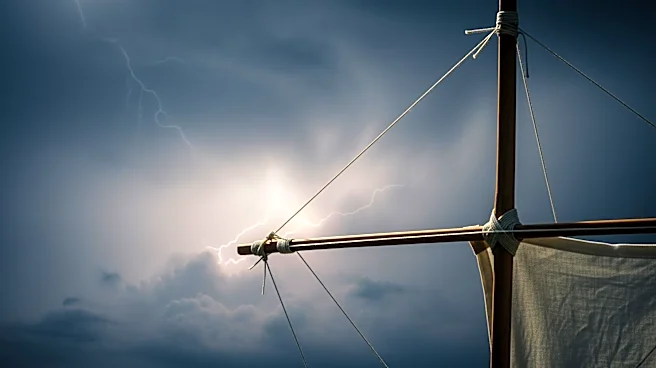









Benjamin Franklin's kite experiment is one of the most famous scientific experiments in history, yet it is often misunderstood and surrounded by myths. By examining the details of the experiment, we can separate fact from fiction and appreciate the true significance of Franklin's work.
The Myth of Lightning Strikes
One of the most pervasive myths about Franklin's kite experiment is that the kite was struck by lightning. This dramatic image has been popularized in stories and illustrations,
but it is not accurate. In reality, Franklin's kite was not struck by lightning, which would have been extremely dangerous and likely fatal.
Instead, the kite was used to collect an electrical charge from a storm cloud. Franklin observed that the loose threads of the hemp string repelled each other, indicating that the string had become electrically charged. He was able to transfer some of this charge to a Leyden jar by touching it to the key attached to the string. This process demonstrated the electrical nature of lightning without the need for a direct strike.
The Role of the Silk Cord
Another misconception is that Franklin held the kite string directly, risking electrocution. In fact, Franklin used a silk cord as an insulator, allowing him to control the kite without touching the conducting string of wet hemp. This precaution was crucial in ensuring his safety during the experiment.
Franklin and his son William sheltered from the rain in an open shed to keep the silk cord and key dry. This setup allowed them to conduct the experiment safely and effectively, highlighting Franklin's careful planning and understanding of electrical principles.
The Experiment's True Significance
While the dramatic image of a lightning strike may capture the imagination, the true significance of Franklin's kite experiment lies in its contribution to the understanding of electricity. By demonstrating that storm clouds carry an electrical charge, Franklin provided empirical evidence for the connection between electricity and lightning.
This discovery was a major milestone in the study of electricity, paving the way for future advancements in the field. Franklin's work helped establish the scientific method as a tool for exploring natural phenomena, emphasizing the importance of observation and experimentation.
In debunking the myths surrounding Franklin's kite experiment, we can appreciate the ingenuity and impact of his work. The experiment remains a symbol of scientific curiosity and the pursuit of knowledge, inspiring generations to explore the mysteries of the natural world with rigor and creativity.