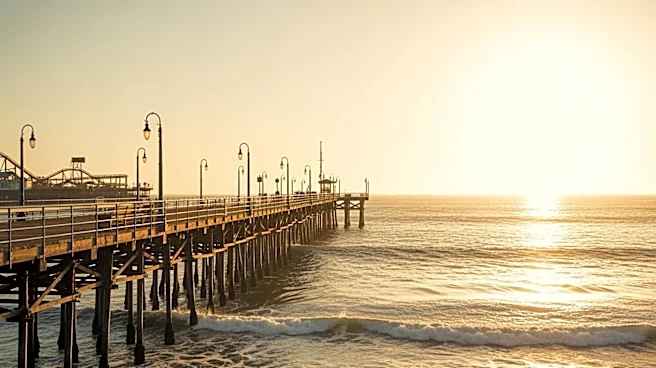




The Santa Monica Pier is a landmark that has stood the test of time, evolving from a simple municipal structure to a vibrant hub of entertainment and culture. Located at the foot of Colorado Avenue in Santa Monica, California, the pier has a rich history that dates back to its opening in 1909. Over the years, it has undergone numerous transformations, each adding a new layer to its storied past.
Early Beginnings
The Santa Monica Pier originally opened on September
9, 1909, as the Municipal Pier. Its primary purpose was to carry sewer pipes beyond the breakers, and it had no amenities for visitors. Despite its utilitarian beginnings, the pier quickly became a popular spot for locals and tourists alike, drawn by the stunning views of the Pacific Ocean.
In 1916, a significant development occurred with the construction of the Pleasure Pier, also known as Newcomb Pier. Built by Charles I. D. Looff and his son Arthur, this adjoining pier was designed as an amusement park. It featured attractions such as the Santa Monica Looff Hippodrome, which housed a carousel and is now listed on the National Register of Historic Places. The Pleasure Pier marked the beginning of the pier's transformation into a center of entertainment.
Challenges and Changes
The Great Depression in the 1930s brought challenges to the Santa Monica Pier, leading to the closure of many amusement facilities. However, the pier remained a popular fishing spot and a beloved community landmark. In 1934, a breakwater was constructed, providing docking for fishing and pleasure boats, which helped sustain the pier's popularity.
The mid-20th century saw further changes, including the construction of a bridge and entry gate in 1938 by the federal Works Project Administration. This replaced the former grade connection and improved access to the pier. Despite these developments, the pier faced threats of demolition in the 1960s and 1970s, as plans for a resort island were proposed. However, local activists successfully campaigned to save the pier, preserving its historical significance.
Modern Era and Restoration
The 1980s brought new challenges when winter storms severely damaged the pier, leading to the destruction of a significant portion of its structure. In response, the city formed the Santa Monica Pier Restoration Corporation to oversee repairs and revitalization efforts. By 1996, the pier welcomed Pacific Park, a new amusement park that marked the first major addition since the 1930s.
Today, the Santa Monica Pier stands as a testament to resilience and community spirit. It continues to attract visitors from around the world, offering a blend of historical charm and modern attractions. The pier's evolution from a simple municipal structure to a vibrant cultural icon reflects the dynamic history of Santa Monica itself.