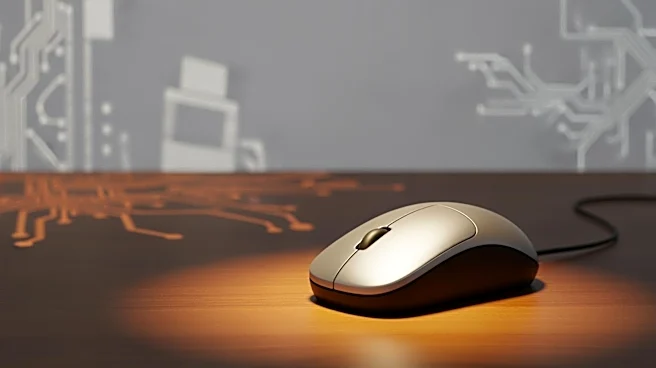






Douglas Engelbart was a pioneering engineer whose work laid the foundation for modern computing. Best known for inventing the computer mouse, Engelbart's contributions extend far beyond this single device. His vision for human-computer interaction and collaborative computing has shaped the way we use technology today. Engelbart's journey from a young engineer to a celebrated inventor is a story of innovation, perseverance, and profound impact.
Early Life and Education
Born
in Portland, Oregon, in 1925, Douglas Engelbart grew up with a keen interest in technology and engineering. He attended Oregon State University, where he earned a bachelor's degree in electrical engineering. His time in the United States Navy as a radar technician further fueled his interest in computing and information systems.
Engelbart's academic pursuits continued at the University of California, Berkeley, where he obtained a master's degree and a Ph.D. in electrical engineering. His doctoral research focused on storage devices, leading to several patents and a brief stint as an assistant professor.
The Augmentation Research Center
Engelbart's vision for computing was inspired by Vannevar Bush's article "As We May Think," which he read during his time in the Navy. This vision led him to establish the Augmentation Research Center (ARC) at SRI International in the 1960s. Engelbart's goal was to enhance human intellect through technology, a concept he termed "bootstrapping strategy."
At ARC, Engelbart and his team developed the oN-Line System (NLS), which included the computer mouse, bitmapped screens, word processing, and hypertext. These innovations were showcased at "The Mother of All Demos" in 1968, demonstrating the potential of interactive computing.
Legacy and Recognition
Douglas Engelbart's contributions to computing have been widely recognized. He received numerous awards, including the ACM Turing Award in 1997 and the National Medal of Technology in 2000. Engelbart's work has influenced countless technologies and continues to inspire new generations of inventors and engineers.
Despite his groundbreaking achievements, Engelbart faced challenges in gaining support for his ideas. His focus on collaborative computing and networked systems was ahead of its time, and he often struggled to secure funding and interest from commercial entities.
Engelbart's legacy is one of innovation and foresight. His work has transformed the way we interact with computers, and his vision for enhancing human capabilities through technology remains relevant today. As we continue to explore new frontiers in computing, Engelbart's contributions serve as a reminder of the power of visionary thinking.