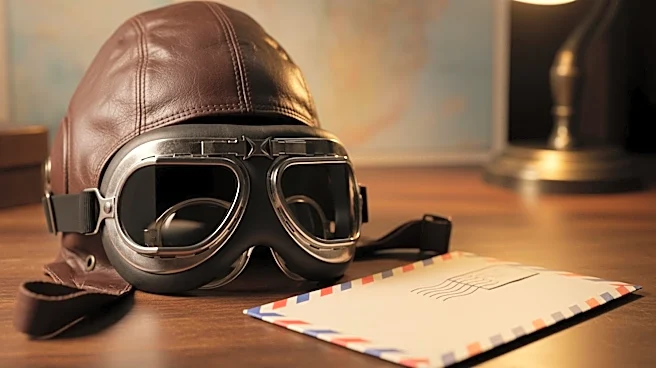






The U.S. airmail service owes much of its success to the pioneering individuals who laid the groundwork for its development. These early aviators and visionaries played crucial roles in establishing and expanding the service, overcoming numerous challenges along the way. Their contributions not only advanced the airmail service but also helped shape the future of aviation.
Augustus Post: The Visionary
Augustus Post was a key figure in the establishment of the U.S. airmail service.
As the Secretary of the Aero Club of America, Post was instrumental in designing the first scheduled airmail route between Washington, D.C., and New York City. His vision for a transcontinental airmail service was driven by the potential for faster and more efficient mail delivery compared to railroads.
Post's background in aviation and his experience with the Aerial Experiment Association, where he worked alongside Alexander Graham Bell, equipped him with the knowledge and skills needed to design the initial airmail routes. His efforts laid the foundation for the expansion of airmail services across the United States.
Major Reuben H. Fleet: The Organizer
Major Reuben H. Fleet played a pivotal role in organizing the first scheduled airmail flights. As the officer in charge of the U.S. Army Air Service's airmail operations, Fleet was responsible for overseeing the logistics of the inaugural flights on May 15, 1918. Under his command, six Curtiss JN-4HM "Jenny" biplanes were used to transport mail between Washington, D.C., Philadelphia, and New York City.
Fleet's leadership and organizational skills were crucial in ensuring the success of the early airmail operations. His work helped demonstrate the viability of airmail as a reliable means of communication, paving the way for its expansion and eventual commercialization.
James C. Edgerton: The Trailblazer
James C. Edgerton was one of the first pilots to fly airmail for the U.S. Army Air Service. On the inaugural day of scheduled airmail service, Edgerton flew the Philadelphia to Washington, D.C., leg, completing the journey successfully. Over the next five months, he flew numerous airmail trips, covering thousands of miles and honing his skills as an aviator.
Edgerton's contributions extended beyond his role as a pilot. He later became the Superintendent of Flying Operations for the Post Office Department, where he played a key role in organizing and improving airmail services. His efforts in establishing aeronautical radio stations and training civilian pilots further advanced the airmail service and the aviation industry as a whole.
The pioneers of the U.S. airmail service were instrumental in its success and growth. Their dedication and innovation not only transformed mail delivery but also laid the groundwork for the development of commercial aviation.