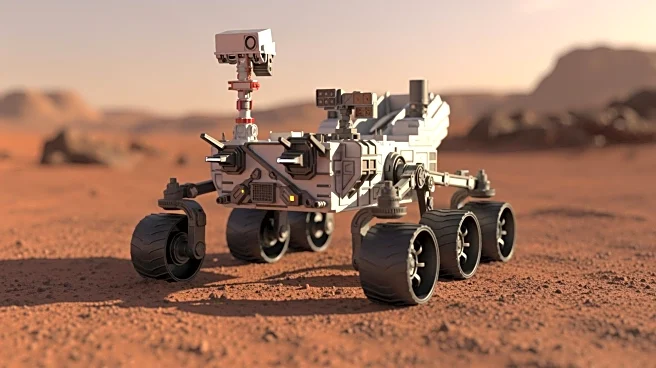



The Mars Exploration Rover (MER) mission, launched by NASA in 2003, was a pivotal moment in the exploration of Mars. With the deployment of two rovers, Spirit and Opportunity, the mission aimed to uncover the planet's geological history and assess its potential to support life. Over the years, the rovers made groundbreaking discoveries that have significantly advanced our understanding of Mars and its past.
Discovering Evidence of Water
One of the primary objectives of the MER
mission was to search for evidence of past water activity on Mars. Both Spirit and Opportunity were equipped with scientific instruments designed to analyze the Martian surface and identify minerals that formed in the presence of water. The mission's findings were nothing short of revolutionary, providing compelling evidence that Mars was once a wetter and potentially habitable planet.
Opportunity's exploration of Meridiani Planum revealed the presence of hematite spherules, known as "blueberries," which are indicative of water-related processes. The rover also discovered sedimentary rock layers, suggesting that the region was once covered by water. These findings were crucial in confirming that Mars had environments capable of supporting life in the past.
Spirit, on the other hand, explored the Columbia Hills in Gusev Crater, where it found evidence of past hydrothermal activity. The rover detected minerals such as goethite, which forms only in the presence of water, providing direct evidence of aqueous processes. Spirit's discovery of silica-rich soil further suggested that hot springs or fumaroles may have existed in the area, offering additional insights into Mars' geological history.
Analyzing Martian Geology
The MER mission also aimed to characterize the geology of Mars, including the distribution and composition of minerals, rocks, and soils. Both rovers conducted detailed analyses of the Martian surface, providing valuable data on the planet's geological processes and history.
Spirit's exploration of Gusev Crater revealed a diverse range of rock types, including basaltic rocks and altered volcanic materials. The rover's findings suggested that the region had undergone significant geological changes, including volcanic activity and water-related processes. Spirit's analysis of the Columbia Hills provided further evidence of past water activity, with the detection of sulfates and other minerals that form in wet conditions.
Opportunity's journey across Meridiani Planum uncovered a landscape shaped by water-related processes. The rover discovered ancient shorelines and sedimentary rock formations, indicating that the area had once been covered by a salty sea. These findings provided crucial insights into the planet's geological history and its potential to support life.
The Legacy of the MER Mission
The scientific achievements of the MER mission have had a lasting impact on our understanding of Mars and its potential habitability. The data collected by Spirit and Opportunity continues to inform current and future Mars missions, guiding scientists in their quest to uncover the planet's secrets.
The mission's success was a testament to the ingenuity and perseverance of the teams behind it. Despite facing numerous challenges, including dust storms and mechanical issues, the rovers continued to operate well beyond their expected lifespans, providing a wealth of data that has significantly advanced our knowledge of Mars.
The legacy of the MER mission extends beyond its scientific discoveries. Spirit and Opportunity have inspired a new generation of explorers, demonstrating the potential for robotic exploration and the importance of perseverance in the pursuit of knowledge. As we continue to explore Mars and search for signs of life, the contributions of the MER mission will remain a cornerstone of our understanding of the Red Planet.