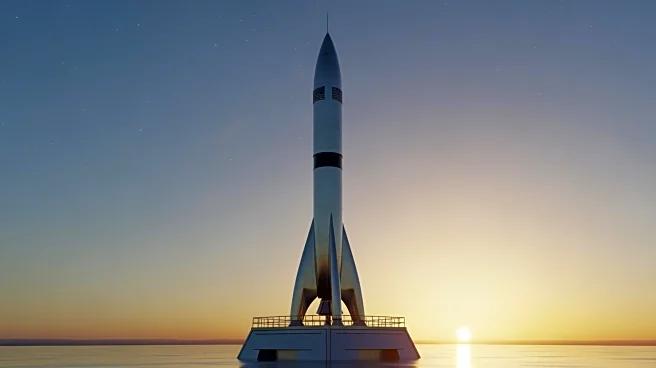



In 1958, the United States made a significant leap in space exploration with the launch of Explorer 1, its first successful satellite. This event marked a pivotal moment in the Space Race, a period of intense competition between the U.S. and the Soviet Union during the Cold War. Explorer 1 not only demonstrated America's technological capabilities but also contributed to scientific discoveries that would shape future space missions.
The Context of the Space Race
The launch of Explorer
1 was a direct response to the Soviet Union's earlier achievements in space. In 1957, the Soviets had successfully launched Sputnik 1 and Sputnik 2, the first artificial satellites, which intensified the rivalry between the two superpowers. The U.S. was determined to catch up, and Explorer 1 was its answer. The satellite was part of the International Geophysical Year, a global scientific initiative that aimed to advance our understanding of Earth and space.
Explorer 1 was launched on February 1, 1958, from Cape Canaveral, Florida, using a Juno I rocket. This launch was a collaborative effort between the Jet Propulsion Laboratory (JPL) and the Army Ballistic Missile Agency (ABMA). The mission was completed in just 84 days, showcasing the urgency and determination of the U.S. to establish its presence in space.
Scientific Contributions of Explorer 1
One of the most significant achievements of Explorer 1 was the discovery of the Van Allen radiation belt. The satellite was equipped with scientific instruments designed by Dr. James Van Allen, which detected charged particles trapped by Earth's magnetic field. This discovery was a major breakthrough in space science, providing valuable insights into the Earth's magnetosphere and laying the groundwork for future research.
Explorer 1's scientific payload included a Geiger-Müller tube to measure cosmic rays, temperature sensors, and micrometeorite detectors. Despite the limited technology of the time, these instruments provided crucial data that helped scientists understand the space environment. The satellite transmitted data for nearly four months before its batteries were exhausted, but it remained in orbit until 1970.
Legacy and Impact
The success of Explorer 1 had a lasting impact on the U.S. space program. It was the first in a series of Explorer satellites, which continued to contribute to scientific research and technological advancements. The mission demonstrated the potential of space exploration and inspired further developments in satellite technology.
Explorer 1 also played a role in shaping public perception of space exploration. It was a symbol of American ingenuity and determination, boosting national pride and interest in science and technology. The satellite's legacy is preserved in museums, where replicas and artifacts continue to educate and inspire future generations.
The launch of Explorer 1 was more than just a technological achievement; it was a turning point in the history of space exploration, setting the stage for the many discoveries and innovations that followed.