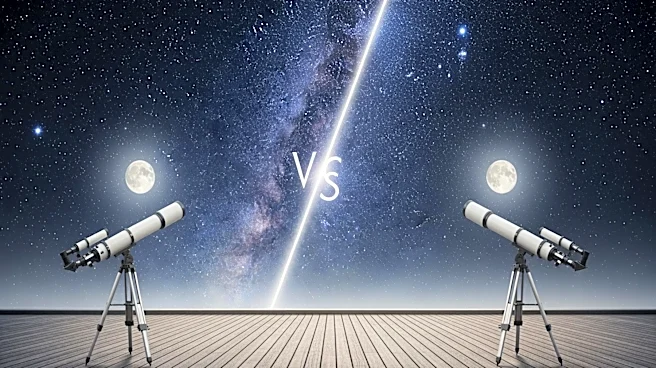

The Great Debate of 1920, featuring Harlow Shapley and Heber Curtis, was a landmark event that significantly influenced the trajectory of modern astronomy. By addressing the nature of spiral nebulae and the universe's
size, the debate set the stage for future discoveries and reshaped our understanding of the cosmos.
Shifting Perspectives on the Universe
Before the Great Debate, the prevailing view was that the Milky Way constituted the entire universe. Shapley, a proponent of this view, argued that spiral nebulae were part of the Milky Way, emphasizing the galaxy's vast size. His work on globular clusters and Cepheid variables supported this perspective, suggesting a universe centered around the Milky Way.
Curtis, however, challenged this notion by proposing that spiral nebulae were independent galaxies. His observations of novae in the Andromeda nebula and the large radial velocities of spiral nebulae led him to conclude that these were separate "island universes." This idea expanded the known universe and introduced the concept of multiple galaxies, each similar in size and nature to the Milky Way.
The Role of Edwin Hubble
The debate's impact was further solidified by Edwin Hubble's subsequent discoveries. Using Cepheid variable stars, Hubble measured the distance to the Andromeda nebula, proving it was far outside the Milky Way. This finding confirmed Curtis's view and established the existence of other galaxies, fundamentally altering our understanding of the universe's structure.
Hubble's work laid the foundation for the field of extragalactic astronomy, which studies galaxies beyond the Milky Way. His discoveries also contributed to the development of the Big Bang theory, as they provided evidence for an expanding universe. The Great Debate, therefore, played a crucial role in shifting the focus of astronomical research from a Milky Way-centered universe to a vast cosmos filled with countless galaxies.
Lasting Influence on Astronomy
The Great Debate's influence extends beyond its immediate impact on astronomical theories. It highlighted the importance of questioning established beliefs and encouraged a more open-minded approach to scientific inquiry. The debate also underscored the value of observational evidence in shaping our understanding of the universe.
Today, the legacy of the Great Debate continues to inspire astronomers as they explore the cosmos. It serves as a reminder of the dynamic nature of scientific discovery and the importance of challenging assumptions to advance our knowledge of the universe.