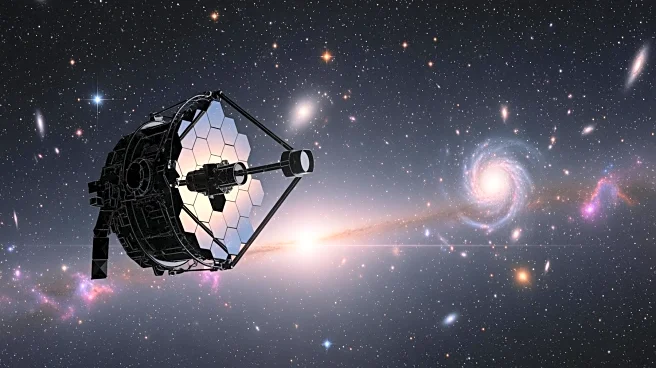

The James Webb Space Telescope (JWST) is a testament to decades of scientific ambition and engineering prowess. As the successor to the Hubble Space Telescope, the JWST was conceived to push the boundaries
of our understanding of the universe. Its journey from conception to launch was marked by numerous challenges, including technical hurdles, budgetary constraints, and delays. Despite these obstacles, the telescope was successfully launched on December 25, 2021, marking the beginning of a new era in space exploration.
Early Development and Challenges
The idea for a next-generation space telescope began to take shape in the early 1990s, as scientists and engineers sought to build on the successes of the Hubble Space Telescope. Initial designs for what was then called the Next Generation Space Telescope began in 1996, with a proposed launch date of 2007 and a budget of $1 billion. However, the project soon faced significant cost overruns and delays.
A major redesign in 2005 addressed some of the technical challenges, but the project continued to experience setbacks. Construction was completed in 2016, followed by years of exhaustive testing. By the time of its launch, the total cost of the JWST had ballooned to $10 billion. Despite these challenges, the telescope's development was a collaborative effort involving thousands of scientists, engineers, and technicians from 15 countries.
Launch and Deployment
The JWST was launched on an Ariane 5 rocket from Kourou, French Guiana. The launch was a critical moment for the project, as the telescope's complex deployment sequence required precise execution. The JWST's journey to its final destination, a solar orbit near the Sun-Earth L2 Lagrange point, took about a month.
During this time, the telescope underwent a series of carefully planned deployments, including the unfolding of its sunshield and the alignment of its mirrors. These steps were crucial for ensuring the telescope's instruments could operate at the extremely cold temperatures required for infrared observations. The successful deployment of the JWST was a testament to the meticulous planning and testing that had gone into the project.
Looking Ahead
With its launch and deployment complete, the JWST is poised to begin its scientific mission. Its advanced capabilities will allow it to observe the universe in unprecedented detail, providing insights into the formation of stars and galaxies, the potential for life on exoplanets, and the nature of dark matter and dark energy.
The JWST's journey from conception to launch was a long and challenging one, but its successful deployment marks a significant achievement in the field of astronomy. As it begins its mission, the telescope promises to expand our understanding of the universe and inspire future generations of scientists and engineers.