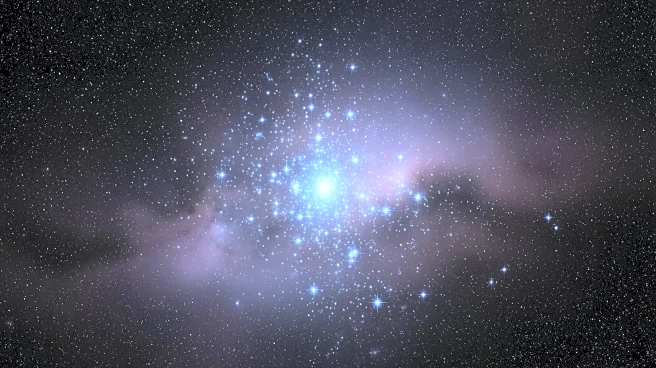


The Beehive Cluster, also known as Praesepe or M44, is a fascinating open cluster located in the constellation Cancer. Known since ancient times, this cluster is one of the nearest open clusters to Earth and holds a significant place in both astronomy and mythology. With its rich population of stars and historical significance, the Beehive Cluster offers a captivating glimpse into the universe.
A Closer Look at the Beehive Cluster
The Beehive Cluster is an open cluster, which means it
is a group of stars that were formed from the same giant molecular cloud and are loosely bound by mutual gravitational attraction. Located approximately 610 light-years from Earth, it contains around 1,000 stars, making it one of the larger clusters visible to the naked eye under dark skies. The cluster's apparent magnitude is 3.7, and it spans about 95 arcminutes in the sky, making it a prominent feature in the constellation Cancer.
The cluster's age is estimated to be between 600 and 700 million years, and it shares similar origins with the Hyades cluster. This similarity is evident in their age and proper motion, suggesting a common formation history. The Beehive Cluster contains a variety of stars, including red giants, white dwarfs, and many main sequence stars, providing a rich field for astronomical study.
Historical Significance and Observations
The Beehive Cluster has been known since ancient times and was described by the classical astronomer Ptolemy as a "nebulous mass in the breast of Cancer." It was one of the first objects studied by Galileo with his telescope, who was able to resolve it into individual stars. The cluster's historical significance is further highlighted by its inclusion in Charles Messier's famous catalog of astronomical objects, where it is listed as M44.
Throughout history, the Beehive Cluster has been associated with various myths and legends. In Greek mythology, it was seen as a manger from which two donkeys, represented by the stars Asellus Borealis and Asellus Australis, are eating. These donkeys were said to have been ridden by Dionysus and Silenus into battle against the Titans.
Modern Discoveries and Research
In recent years, the Beehive Cluster has continued to be a subject of interest for astronomers. In 2012, two planets were discovered orbiting stars within the cluster, marking the first time planets were found around Sun-like stars in a stellar cluster. These planets, known as hot Jupiters, are massive gas giants that orbit very close to their parent stars.
The discovery of these planets has opened new avenues for research, as it provides insights into the formation and evolution of planetary systems in different environments. The Beehive Cluster remains a valuable target for both amateur and professional astronomers, offering a window into the processes that shape our universe.