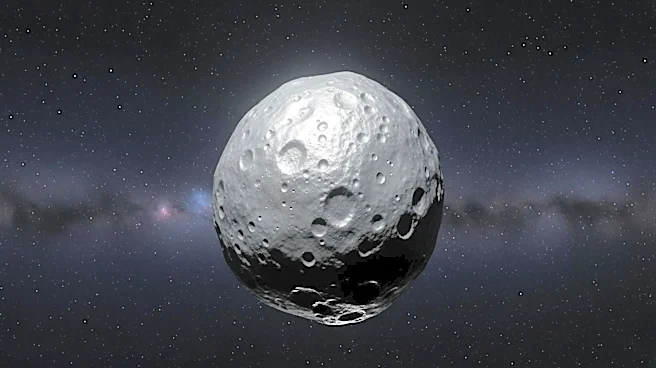







3 Juno is not just another asteroid in the vast expanse of the asteroid belt. It possesses unique orbital and physical characteristics that distinguish it from many of its peers. This article explores the distinctive features of 3 Juno, including its orbit, reflectivity, and surface properties, which have intrigued astronomers since its discovery.
Orbital Characteristics
3 Juno's orbit is one of its most fascinating features. It orbits the Sun at a mean distance slightly
closer than Ceres or Pallas, two other well-known asteroids. What sets Juno apart is its highly eccentric orbit, which is more extreme than that of Pluto. This eccentricity means that Juno comes closer to the Sun at its perihelion than Vesta and travels further out at its aphelion than Ceres.
This unusual orbit was the most eccentric known until the discovery of 33 Polyhymnia in 1854. Among asteroids over 200 km in diameter, only 324 Bamberga has a more eccentric orbit. Juno's orbit is also moderately inclined at about 12 degrees to the ecliptic, adding another layer of complexity to its path around the Sun.
Reflectivity and Surface Properties
3 Juno is classified as an S-type asteroid, known for its stony composition. However, Juno is unusually reflective compared to other S-type asteroids. This high albedo, or reflectivity, suggests distinct surface properties that may differ from other asteroids in its class. The reflectivity contributes to its relatively high apparent magnitude, making it visible even when it is not near the inner edge of the asteroid belt.
At favorable oppositions, Juno can reach a magnitude of +7.5, which is brighter than Neptune or Titan. This brightness is one reason why Juno was discovered before larger asteroids like Hygiea, Europa, Davida, and Interamnia. However, at most oppositions, Juno's magnitude is around +8.7, making it just visible with binoculars.
Surface Composition and Features
Spectroscopic studies of Juno's surface have provided insights into its composition. The surface is believed to be similar to that of chondrites, a common type of stony meteorite composed of iron-bearing silicates such as olivine and pyroxene. Infrared images have revealed a large crater or ejecta feature, approximately 100 km wide, indicating a geologically young impact.
These characteristics make 3 Juno a subject of ongoing interest for astronomers. Its unique orbit and reflective surface offer valuable clues about the history and evolution of the asteroid belt. As technology advances, further studies of Juno may reveal even more about this intriguing celestial body, enhancing our understanding of the solar system's dynamic nature.