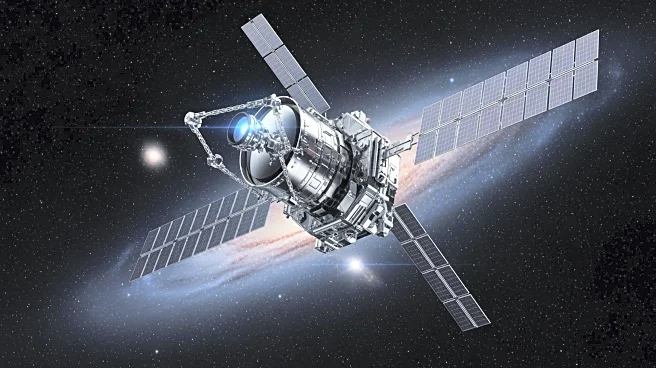

The Hubble Space Telescope stands as a testament to human engineering and scientific ambition. Launched in 1990, Hubble's design and construction involved overcoming numerous technical challenges to create
one of the most advanced observatories in space. Its sophisticated instruments and systems have allowed it to capture breathtaking images and make groundbreaking discoveries.
Optical Design and Instruments
Hubble is a Cassegrain reflector telescope with a 2.4-meter mirror, designed to observe ultraviolet, visible, and near-infrared light. Its orbit outside Earth's atmosphere enables it to capture high-resolution images with minimal background light. The telescope's optical system was crafted to exacting specifications, with the mirror polished to an accuracy of 10 nanometers.
The telescope's initial instruments included the Wide Field and Planetary Camera, Goddard High Resolution Spectrograph, and Faint Object Camera, among others. These instruments were designed to study various aspects of the universe, from high-resolution imaging to ultraviolet spectroscopy. Over the years, servicing missions have upgraded Hubble's instruments, enhancing its capabilities and extending its operational life.
Engineering Challenges and Solutions
Hubble's construction faced several hurdles, including budget constraints and technical delays. The telescope's main mirror was initially ground incorrectly, resulting in spherical aberration. This flaw was corrected during the first servicing mission in 1993, which installed corrective optics and replaced several components.
Hubble is unique in its design for in-space maintenance, allowing astronauts to repair and upgrade its systems. Five servicing missions have replaced instruments, repaired components, and boosted Hubble's orbit, ensuring its continued operation. These missions demonstrated the feasibility of in-space repairs and set a precedent for future space telescopes.
Future Prospects and Legacy
Hubble's technical achievements have paved the way for future space observatories. Its successor, the James Webb Space Telescope, launched in 2021, builds on Hubble's legacy with advanced infrared capabilities. Hubble's design and engineering have influenced the development of other telescopes, highlighting the importance of adaptability and maintenance in space missions.
The Hubble Space Telescope remains a marvel of engineering, showcasing the ingenuity and perseverance required to explore the cosmos. Its technical design and successful operation have set a high standard for future space telescopes, ensuring that Hubble's legacy will continue to inspire and inform generations to come.