


Death Valley, a desert valley in Eastern California, is not only known for its extreme climate but also for its fascinating geological history. This region has undergone significant geological transformations over millions of years, resulting in the unique landscape we see today. This article explores the geological history of Death Valley, highlighting the processes that have shaped its current form.
Formation and Early Geological Activity
The geological history of Death Valley dates back
to the Proterozoic era, with the oldest rocks in the region being extensively metamorphosed and at least 1.7 billion years old. These ancient rocks were formed during a time when the area was covered by warm, shallow seas that deposited marine sediments. Over time, these sediments were buried and metamorphosed, creating the complex geological structures found in the valley today.
During the Neoproterozoic era, the supercontinent Rodinia began to break apart, leading to the formation of the Pacific Ocean. This rifting event created a new continental margin, resulting in the deposition of the Noonday Dolomite, a carbonate shelf that formed as the region subsided. This period marked the beginning of significant geological changes that would continue to shape Death Valley.
Tectonic Activity and Basin Formation
The tectonic activity that has shaped Death Valley began in earnest during the Mesozoic era. The western edge of the North American continent was pushed against the oceanic plate under the Pacific Ocean, creating a subduction zone. This led to the formation of the Sierran Arc, a line of volcanoes and uplifting mountains that contributed to the region's complex geology.
The current Basin and Range topography of Death Valley began to form around 16 million years ago. This period of crustal stretching and faulting created the graben structure of the valley, with the Panamint Range to the west and the Amargosa Range to the east. The valley's unique topography is a result of these tectonic processes, which continue to shape the region today.
Recent Geological Changes and Features
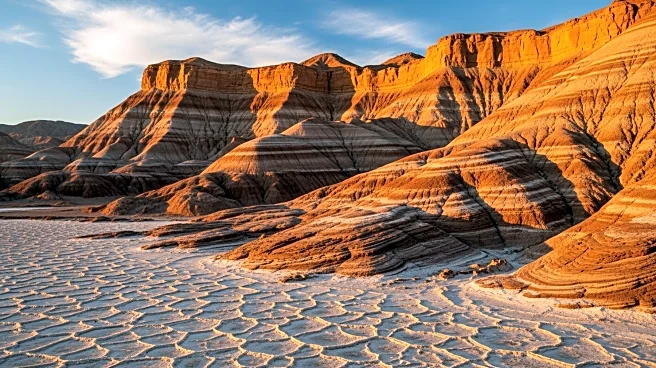
In more recent geological history, Death Valley has experienced significant changes due to climatic fluctuations. During the Pleistocene era, the valley was filled with a large lake known as Lake Manly. As the climate became more arid, the lake evaporated, leaving behind the salt flats and playas that are characteristic of the valley today.
The valley's geological features, such as the salt pans and alluvial fans, are a testament to the dynamic processes that have shaped the region. The salt pans, for example, are remnants of the evaporated Lake Manly, while the alluvial fans are formed by sediment deposited by flash floods from the surrounding mountains.
In conclusion, the geological history of Death Valley is a story of dramatic transformations and ongoing tectonic activity. From its ancient marine origins to its current desert landscape, the valley's geology provides a window into the Earth's dynamic processes. This rich geological history continues to attract scientists and visitors alike, eager to explore the unique features of this remarkable region.