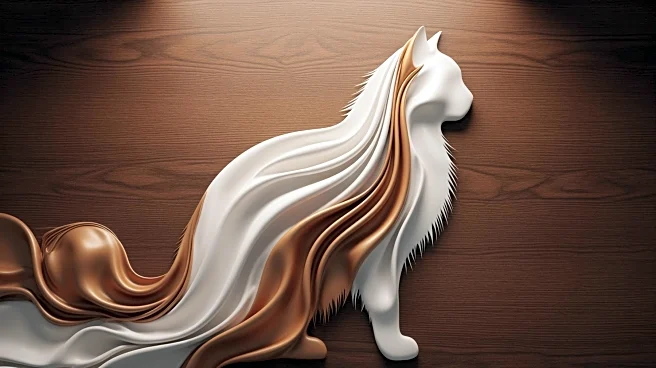



The Balinese cat, known for its long-haired coat and striking Siamese-style coloration, has a fascinating history that traces back to a natural mutation of the Siamese breed. This article delves into the origins and development of the Balinese cat, highlighting key milestones and the efforts of breeders to establish it as a distinct breed.
Early Beginnings
The story of the Balinese cat begins with the Siamese cats imported from Thailand to the United States and the United Kingdom
in the mid-1800s. Some of these Siamese cats carried a recessive gene for long hair, which occasionally resulted in long-haired kittens. Initially, these kittens were considered a fault in the Siamese bloodline and were sold as pets rather than show cats. However, records of these long-haired Siamese date back to the early 1900s, indicating their presence long before they were recognized as a separate breed.
In 1928, the American Cat Fanciers' Federation registered the first long-haired Siamese as show cats. Despite this early recognition, it wasn't until the mid-1950s that breeders in the United States began to seriously develop the long-haired variant as a distinct breed. The name "Balinese" was chosen by breeder Helen Smith, inspired by the grace of Balinese dancers, to replace the cumbersome "Long-haired Siamese."
Establishing the Breed Standard
The 1960s and 1970s were pivotal decades for the Balinese breed, thanks in large part to the efforts of Sylvia Holland, a breeder and illustrator for Walt Disney Studios. Holland worked diligently to establish a breed standard, focusing on cats that exhibited the classic Siamese points in seal, chocolate, blue, and lilac. She was adamant about maintaining the purity of the breed, refusing to accept cats with other point colors, which she believed resulted from crossbreeding with other breeds.
During this time, the American Cat Fanciers' Association classified Siamese cats with newer point colors, such as red and cream, as a separate breed called the Colorpoint Shorthair. The long-haired cats with these colors were subsequently classified as "Javanese," maintaining the Indonesian island theme.
Modern Developments
As the Balinese breed gained popularity, it split into two varieties based on physical type: the traditional or "old-style" Balinese and the modern Balinese. The traditional type, also known as "apple-head," closely resembles the early breeding programs, while the modern type features a more elongated, slender body with a wedge-shaped head.
By the mid-1980s, the old-style Balinese had largely disappeared from cat shows, with only a few breeders maintaining the original type. In 2008, the Cat Fanciers' Association merged the Balinese and Javanese breeds, recognizing Javanese as a color division of the Balinese. This change aimed to increase Balinese registration and encourage new breeders and exhibitors to participate in shows.
The Balinese cat's journey from a genetic anomaly to a recognized breed is a testament to the dedication of breeders who worked tirelessly to preserve and promote this elegant and graceful feline.