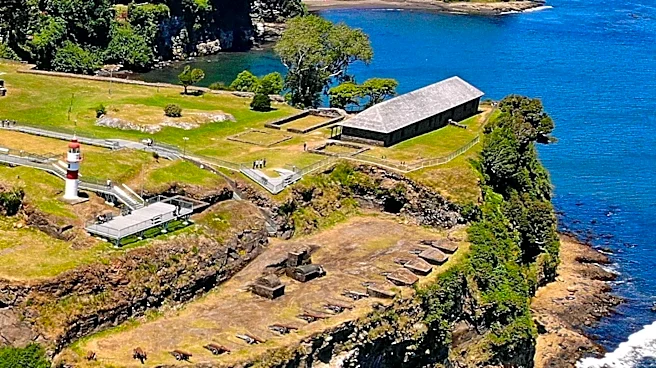




Fort Hamilton, situated on Rose Island in Narragansett Bay, Rhode Island, stands as a testament to early American coastal defense strategies. Constructed between 1798 and 1801, it was part of the First System of U.S. fortifications, a federal initiative to protect the young nation from foreign threats. This article explores the architectural and military design of Fort Hamilton, highlighting its unique features and historical context.
Architectural Design and Features
The design of
Fort Hamilton was the brainchild of French military engineer Louis Tousard, who envisioned it as the largest defensive structure in Narragansett Bay. The fort's plan included four bastions designed to accommodate sixty cannons, a formidable artillery setup for its time. One of the most notable features of Fort Hamilton was its bombproof barracks, among the first of their kind in the United States. These barracks were designed to withstand bombardment, providing a secure refuge for soldiers stationed at the fort.
Another distinctive element of Fort Hamilton's design was its circular bastions. This feature was unusual in early U.S. fortifications, which typically favored more traditional angular designs. The circular bastions were intended to provide a wider field of fire, enhancing the fort's defensive capabilities. Despite its innovative design, the fort was never fully completed due to changes in federal military spending priorities.
Military Context and Construction
The construction of Fort Hamilton was authorized by President John Adams in response to the Quasi-War with France, a period of heightened tensions between the two nations. The fort was part of a broader effort to establish a network of coastal defenses along the U.S. coastline, known as the First System of fortifications. These forts were intended to protect key ports and harbors from potential naval attacks.
Construction began in 1798, with the United States Army Corps of Engineers overseeing the project. However, in 1801, newly elected President Thomas Jefferson reduced federal military spending, leading to the cancellation of Fort Hamilton's construction before it could be completed. Despite this setback, the fort remains a rare example of an intact First System fort, offering valuable insights into early American military architecture.
Legacy and Preservation
Today, Fort Hamilton is recognized for its historical and architectural significance. It is part of the Fort Hamilton Historic District, listed on the National Register of Historic Places since 2001. Preservation efforts are underway to restore the fort's masonry, bastions, and curtain walls, ensuring that this important piece of American history is preserved for future generations.
The fort is open to the public for historical interpretation and educational programs, allowing visitors to explore its unique design and learn about its role in early American coastal defense. Plans are also in place to establish a permanent museum in the bombproof barracks, further enhancing the site's educational value.
Fort Hamilton's enduring legacy as a symbol of early American ingenuity and resilience continues to captivate historians and visitors alike, offering a glimpse into the nation's formative years and its efforts to protect its shores from foreign threats.