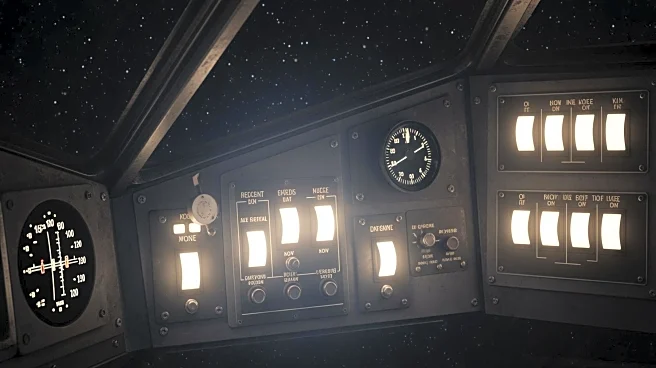

The Apollo 11 mission was a monumental achievement in human spaceflight, showcasing the technical prowess and innovation required to land humans on the Moon. The mission involved overcoming numerous challenges,
from spacecraft design to navigation and landing. The success of Apollo 11 was a testament to the dedication and expertise of the engineers and scientists who made it possible.
Designing the Spacecraft
Apollo 11's spacecraft consisted of three main components: the command module Columbia, the service module, and the lunar module Eagle. Each part played a crucial role in the mission's success. The command module housed the astronauts and was the only part to return to Earth. The service module provided propulsion, electrical power, oxygen, and water, while the lunar module was responsible for landing on the Moon and returning to lunar orbit.
The design of the lunar module was particularly challenging, as it needed to be lightweight yet capable of landing on the Moon's surface and returning to orbit. Engineers had to account for the Moon's lower gravity and lack of atmosphere, which affected landing dynamics. The lunar module's descent and ascent stages were equipped with engines specifically designed for these tasks, ensuring a safe landing and return.
Navigating to the Moon
Navigating to the Moon required precise calculations and coordination. Apollo 11's journey began with a trans-lunar injection, propelling the spacecraft onto a trajectory toward the Moon. The crew relied on the spacecraft's guidance systems and manual navigation to ensure they reached the correct lunar orbit.
Once in lunar orbit, the challenge was to identify a suitable landing site. The Sea of Tranquility was chosen for its relatively flat terrain, minimizing landing risks. The lunar module's descent was a critical phase, requiring careful monitoring of speed and altitude. Neil Armstrong took manual control during the final approach to avoid a boulder-strewn area, demonstrating the importance of human decision-making in conjunction with automated systems.
Overcoming Technical Challenges
Apollo 11 faced several technical challenges during its mission. One notable issue was the 1201 and 1202 program alarms during the lunar descent, indicating the guidance computer was overloaded. Engineers on Earth quickly assessed the situation, allowing the mission to proceed safely. This incident highlighted the importance of robust software and real-time problem-solving.
The mission's success was also due to rigorous testing and preparation. Previous Apollo missions had tested various components and procedures, ensuring reliability. The dedication of the engineers and scientists involved in Apollo 11 was crucial in overcoming these challenges and achieving a successful Moon landing.
Apollo 11's technical triumphs paved the way for future space exploration, demonstrating the potential of human ingenuity and collaboration. The mission remains a landmark in the history of spaceflight, inspiring continued advancements in technology and exploration.