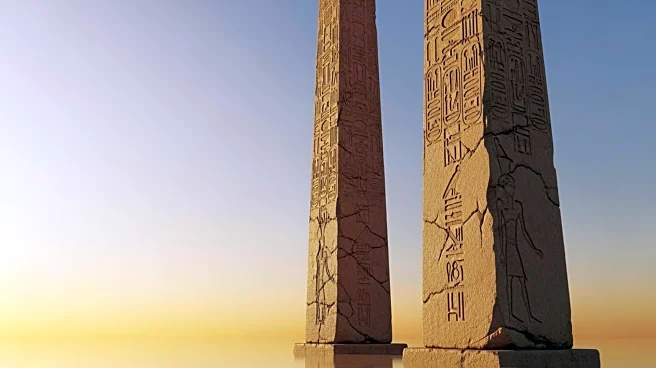

Cleopatra's Needles, the ancient Egyptian obelisks now residing in London and New York City, are more than mere monuments; they are symbols of cultural exchange and diplomacy. These towering structures,
originally crafted in Heliopolis, have traversed time and space to become iconic landmarks in the Western world, reflecting the rich tapestry of historical interactions between Egypt and the West.
Historical Significance
The obelisks known as Cleopatra's Needles were originally erected in Heliopolis during the New Kingdom period, inscribed by Pharaoh Thutmose III and Pharaoh Ramesses II. These obelisks were not only architectural marvels but also embodiments of religious and political power, dedicated to the sun god Ra. Their relocation to Alexandria by the Romans marked the beginning of their journey as symbols of cultural exchange.
In Alexandria, the obelisks stood for nearly two millennia, witnessing the city's transformation under Roman rule and its role as a hub of cultural and intellectual activity. The name Cleopatra's Needles, derived from the Ptolemaic Queen Cleopatra VII, reflects the Western fascination with Egypt's ancient heritage and its legendary figures.
Diplomatic Gifts and Engineering Feats
The relocation of Cleopatra's Needles to London and New York City in the 19th century was a diplomatic gesture that underscored the cultural ties between Egypt and the Western powers. The London needle was presented to the United Kingdom in 1819, while the New York needle was secured for the United States in 1877. These gifts were not only acts of goodwill but also symbols of mutual respect and shared interests.
Transporting these massive stone structures across continents required innovative engineering solutions and considerable resources. The obelisks were moved using custom-built ships and complex logistics, showcasing the technological advancements of the time. Their successful relocation was a testament to human ingenuity and the collaborative spirit of international relations.
Modern-Day Icons
Today, Cleopatra's Needles stand as iconic landmarks in London and New York City, attracting visitors from around the world. The London needle is located on the Victoria Embankment, while the New York needle resides in Central Park, near the Metropolitan Museum of Art. Despite the challenges posed by weather conditions, these obelisks continue to captivate audiences with their ancient inscriptions and historical significance.
As symbols of cultural exchange, Cleopatra's Needles remind us of the enduring legacy of ancient Egypt and the connections between civilizations. They serve as bridges between the past and the present, illustrating the power of cultural diplomacy and the shared heritage that unites us all. Through these obelisks, the story of Egypt's ancient civilization continues to resonate in the modern world, inspiring curiosity and appreciation for the rich tapestry of human history.