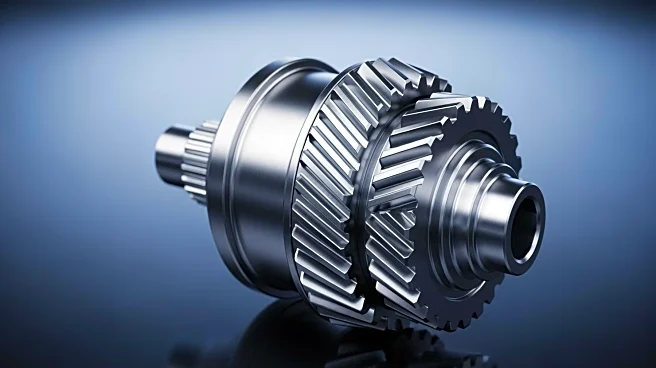


Limited-slip differentials (LSDs) have played a crucial role in the automotive industry, enhancing vehicle performance by improving traction and handling. This article delves into the historical development of LSDs, highlighting key milestones and innovations that have shaped their evolution over the years.
Early Innovations and Development
The concept of limited-slip differentials dates back to the early 20th century. In 1932, Ferdinand Porsche designed the P-Wagen Grand Prix racing
car, which faced challenges with excessive wheel spin due to its powerful V16 engine. To address this issue, Porsche commissioned ZF to develop a limited-slip differential, marking a significant advancement in automotive technology.
By 1935, ZF's "sliding pins and cams" design became available, although it was not technically a limited-slip differential but rather a system composed of two freewheels. This innovation laid the groundwork for future developments in LSD technology, particularly in military vehicles during World War II.
The Rise of LSDs in the Automotive Market
The late 1950s saw the widespread introduction of limited-slip differentials by U.S. automakers. Packard was among the first to offer a clutch-type LSD under the Twin Traction trademark in 1956, promoting it as a solution for driving in severe winter conditions. General Motors followed suit in 1957 with its Positraction system for Chevrolet vehicles.
Other American brands quickly adopted similar systems, each with unique marketing names such as Safe-T-Track for Pontiac and Traction-Lok for Ford. Chrysler also entered the market with Power-Lok and Spin-Resistant units, marketed under the Sure-Grip name. These innovations became highly popular during the muscle car era of the 1960s and 1970s.
Modern Advancements and Applications
Today, limited-slip differentials continue to evolve, incorporating advanced technologies to enhance vehicle performance. Modern LSDs utilize various mechanisms, including viscous and clutch-based designs, to provide optimal traction and handling. The introduction of electronically controlled LSDs has further revolutionized the industry, allowing for precise control of torque distribution.
Electronic traction control systems now emulate LSD functions using brakes, offering an alternative to traditional mechanical systems. These advancements have expanded the applications of LSDs beyond high-performance vehicles, making them a standard feature in many modern cars.
Limited-slip differentials have come a long way since their inception, continually adapting to meet the demands of the automotive industry. As technology advances, LSDs will likely continue to play a vital role in enhancing vehicle safety and performance.