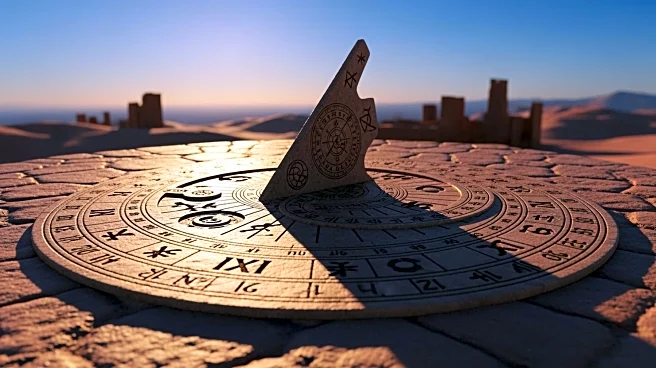




Astronomy played a crucial role in ancient civilizations, serving as a tool for understanding the cosmos and influencing various aspects of daily life. In Mesopotamia and Egypt, astronomical observations were integral to the development of calendars and the prediction of celestial events, laying the groundwork for future scientific advancements.
Mesopotamian Contributions
Mesopotamian astronomers were pioneers in the field, recording detailed observations of the stars, planets,
and lunar cycles on clay tablets. These early astronomers developed mathematical methods to predict celestial events, such as eclipses and the changing length of daylight throughout the year. Their work was foundational, influencing subsequent astronomical practices in the Hellenistic world, India, and the Islamic Golden Age.
The Babylonians were particularly adept at using astronomy for practical purposes, such as calendar-making and astrology. They identified astronomical periods that are still used in Western calendars today, including the solar year and lunar month. The precision of their observations and calculations allowed them to predict lunar phases and planetary movements with remarkable accuracy.
Egyptian Astronomy
In Egypt, astronomy was closely linked to religious practices and the annual flooding cycles of the Nile. Neolithic inhabitants constructed megalithic structures in Nabta Playa, which were used to coordinate astronomical observations and align with solar patterns. These practices contributed to the emergence of cosmology in Old Kingdom Egypt.
Egyptian astronomers developed a calendar system that was simpler than those of their contemporaries, consisting of twelve months with thirty days each, plus five additional days at the end of the year. This calendar was crucial for agricultural planning and religious festivals, demonstrating the practical applications of astronomical knowledge.
Influence on Later Developments
The astronomical achievements of Mesopotamia and Egypt had a lasting impact on later civilizations. Greek and Roman scholars built upon the foundations laid by these ancient astronomers, further advancing the field. The integration of mathematical calculations with astronomical observations became a hallmark of scientific inquiry in the Hellenistic period.
The legacy of ancient astronomy is evident in the continued study and exploration of the cosmos. The methods and principles developed by early astronomers provided a framework for understanding celestial phenomena, influencing scientific thought and practice for centuries. As modern astronomy continues to evolve, the contributions of these ancient civilizations remain a testament to the enduring quest for knowledge.