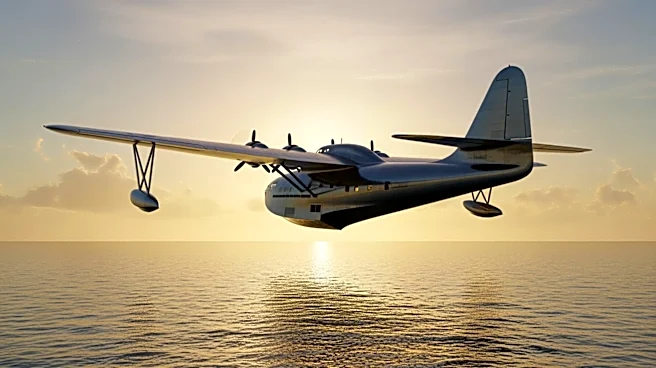




The Sikorsky S-42, a commercial flying boat designed by Igor Sikorsky, was a remarkable aircraft that set new standards in aviation during the 1930s. Developed to meet the requirements of Pan American World Airways, the S-42 featured advanced design elements that made it a standout in its era. Although it was eventually overshadowed by more advanced aircraft, the S-42's contributions to aviation history remain significant.
Design and Development
The Sikorsky S-42 was developed
in response to a request from Pan American World Airways for a long-range flying boat capable of spanning the oceans. The design process began in 1931, with Pan Am president Juan Trippe seeking an aircraft with increased lifting capacity and range. Igor Sikorsky's design featured major aerodynamic improvements over its predecessor, the S-40, including reduced external bracings and a tail attached directly to the hull.
The S-42 was equipped with wing flaps, variable-pitch propellers, and a full-length hull, which supported the tail directly. These innovations contributed to its improved performance and efficiency. The prototype first flew on March 29, 1934, and set ten world records for payload-to-height, earning it the nicknames "Flying Clipper" and "Pan Am Clipper."
Operational History
Pan American Airways was the primary user of the Sikorsky S-42, employing it on routes such as Miami to Rio de Janeiro and New York to Bermuda. The aircraft also operated flights between Seattle and Alaska, as well as between Manila and Hong Kong. Despite its impressive capabilities, the S-42 fell short of the range proposed by Charles Lindbergh, who had consulted on its design.
The S-42's operational history was marked by its role in pioneering long-distance air travel. It conducted proving flights across the Atlantic and Pacific oceans, demonstrating the feasibility of transoceanic flights. However, Pan Am eventually turned to the Martin M-130 for longer-range operations, as the S-42 could not meet the full range requirements with a payload.
Legacy and Impact
Although the Sikorsky S-42 was eventually retired, its impact on aviation was significant. The aircraft's design innovations influenced future flying boat and aircraft designs, contributing to the evolution of long-range air travel. The S-42's ability to set world records and operate on challenging routes showcased the potential of flying boats in commercial aviation.
The Sikorsky S-42 remains a testament to Igor Sikorsky's ingenuity and vision. Its contributions to aviation history continue to be recognized, highlighting the importance of innovation and adaptability in the ever-evolving world of aviation.