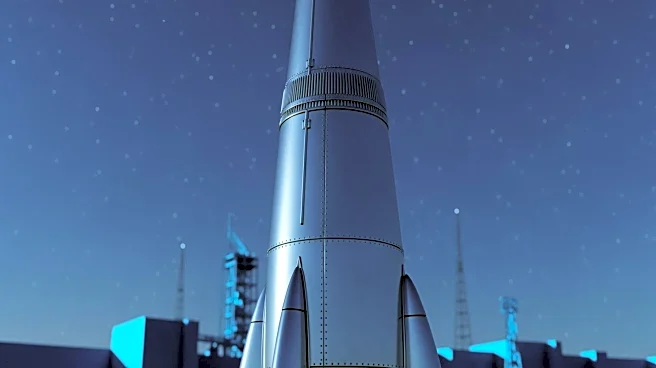




The Saturn I SA-5 launch marked a pivotal moment in the history of U.S. space exploration. As the first Block II launch of the Saturn I rocket, it was a significant step in NASA's Apollo program, demonstrating the United States' growing capabilities in rocketry. Launched on January 29, 1964, this test flight was not just a technical achievement but also a symbol of the nation's determination to surpass Soviet space capabilities.
The Launch and Its Context
The Saturn I SA-5 was
launched from Complex 37, Pad B, and was the first to carry a live second stage, the S-IV. This launch was crucial as it demonstrated the ability to place payloads into orbit, a capability that had been a challenge for the U.S. since the Soviet Union's Sputnik launch. The successful deployment of the S-IV stage in orbit was a testament to the advancements in U.S. rocket technology.
President John F. Kennedy had identified the Saturn I and the SA-5 launch as the point where U.S. lift capability would surpass that of the Soviets. This was a significant political and technological milestone, as the U.S. had been trailing behind since the launch of Sputnik. The SA-5's success was a clear indication that the U.S. was ready to compete on the global stage in space exploration.
Technical Achievements
The Saturn I SA-5 featured several technical advancements that were crucial for its success. The rocket's first stage was powered by eight H-1 engines, which provided the necessary thrust to lift the vehicle into orbit. The second stage, the S-IV, was powered by six RL10 engines, which used liquid hydrogen and liquid oxygen as propellants. This combination of engines and propellants was a significant advancement in rocket technology, allowing for greater efficiency and power.
The guidance system of the Saturn I SA-5 was also noteworthy. The Block II vehicles included an instrument unit that housed the guidance, telemetry, tracking, and power components. This unit was crucial for ensuring the rocket's trajectory and successful deployment of its payload.
Legacy and Impact
The Saturn I SA-5 launch had a lasting impact on the U.S. space program. It paved the way for subsequent launches and the development of more advanced rockets, such as the Saturn IB and Saturn V. These rockets were instrumental in the Apollo program, which ultimately led to the first human landing on the Moon.
The success of the Saturn I SA-5 demonstrated the U.S.'s commitment to space exploration and its ability to innovate and overcome challenges. It was a key milestone that helped establish the U.S. as a leader in space technology and exploration, setting the stage for future achievements in the Apollo program and beyond.