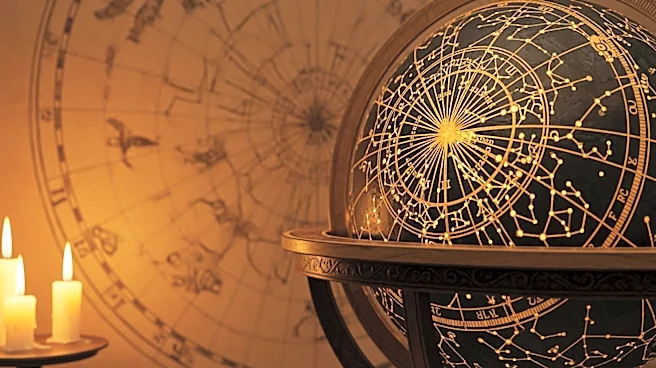







Astrology has long fascinated people with its interpretations of celestial bodies and their influence on human affairs. Among the various elements considered in astrology, stars play a crucial role. Historically, astrologers categorized stars into two main types: fixed stars and wandering stars. This distinction is fundamental to understanding traditional astrological systems and how they interpret the heavens.
Fixed Stars: Anchors in the Firmament
In traditional astrology, fixed stars,
known in Latin as "stellae fixae," are considered to be the stars and other galactic or intergalactic bodies recognized by astronomy. These stars were thought to be attached to the firmament, the most distant of the heavenly spheres from Earth. The term "fixed" implies that these stars maintain a constant position relative to each other, unlike the planets, which move across the sky. Fixed stars were believed to exert a steady influence on the zodiac signs and were often associated with specific astrological degrees.
Astrologers have historically used fixed stars to mark important points in the sky. Each fixed star corresponds to a particular degree in the zodiac, and these degrees must be adjusted for the precession of the equinoxes. This adjustment is crucial for accurate astrological readings, as the positions of the stars shift over time. Fixed stars are often linked to specific constellations and have been used to predict events and interpret personality traits.
Wandering Stars: The Planets of Astrology
In contrast to fixed stars, wandering stars, or "planētes astēr" in Greek, refer to the planets of the Solar System. In astrology, the Sun and Moon are also treated as planets, despite the Sun being a star and the Moon being Earth's satellite. The term "wandering" reflects the observable movement of these celestial bodies across the sky, as they do not remain in a fixed position relative to the stars.
The movement of wandering stars is central to astrological practice. Each planet is associated with specific qualities and influences, and their positions in the zodiac are believed to affect human behavior and events. The Sun, for example, is associated with vitality and identity, while the Moon governs emotions and instincts. The planets' interactions with each other and with the fixed stars form the basis of astrological charts and predictions.
The Interplay of Fixed and Wandering Stars
The interplay between fixed and wandering stars is a key aspect of astrology. While fixed stars provide a stable backdrop, the movement of wandering stars introduces dynamic changes. Astrologers interpret these movements to understand how celestial events might influence earthly affairs. For instance, a planet's conjunction with a fixed star can amplify its effects, leading to significant astrological interpretations.
Astrology's reliance on both fixed and wandering stars highlights the complexity of this ancient practice. By examining the positions and interactions of these celestial bodies, astrologers seek to uncover patterns and insights that can guide individuals in their personal and professional lives. The distinction between fixed and wandering stars remains a foundational concept in astrology, shaping how practitioners interpret the cosmos.