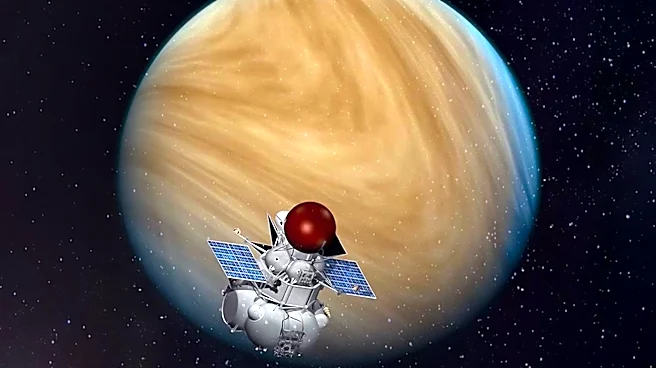








In the late 1960s, NASA embarked on a mission to explore Venus, one of Earth's closest planetary neighbors. This mission, known as Mariner 5, was part of the broader Mariner program aimed at interplanetary exploration. Launched on June 14, 1967, Mariner 5 was designed to study Venus's atmosphere and magnetic fields, providing valuable data that would enhance our understanding of the planet. The mission was a significant milestone in space exploration,
showcasing the capabilities of NASA's Jet Propulsion Laboratory.
Mission Objectives and Design
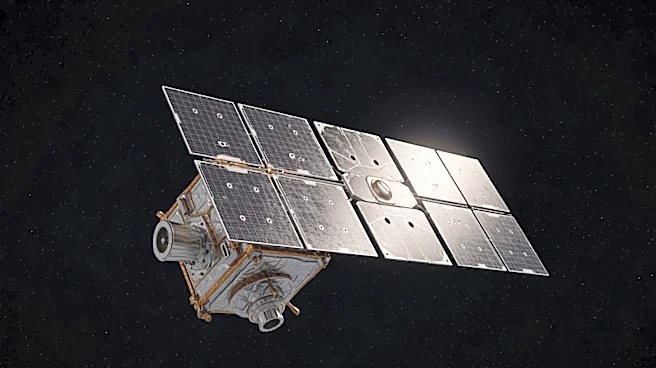
Mariner 5 was initially built as a backup to Mariner 4, which had successfully completed a mission to Mars. However, after Mariner 4's success, Mariner 5 was repurposed for a Venus flyby during the 1967 launch window. The spacecraft was equipped with a suite of scientific instruments designed to probe Venus's atmosphere and measure interplanetary magnetic fields. These instruments included a helium-vector magnetometer, a solar plasma probe, and a trapped radiation detector.
The spacecraft's design was modified to accommodate its new mission. Unlike Mariner 4, Mariner 5 needed to face away from the Sun to keep its high-gain antenna pointed at Earth. This required the solar panels to be reversed to remain sun-facing, ensuring adequate power generation. Additionally, the spacecraft's trajectory brought it closer to the Sun, necessitating a reduction in solar panel size to save mass and make room for additional antennas.
The Venus Flyby
Mariner 5's closest approach to Venus occurred on October 19, 1967, at a distance of 3,990 kilometers. The spacecraft's more sensitive instruments, compared to its predecessor Mariner 2, allowed it to gather detailed data on Venus's atmosphere and interplanetary conditions. The mission provided new insights into the hot, cloud-covered planet, revealing a very hot surface and a denser atmosphere than previously expected.
The data collected by Mariner 5 was analyzed alongside information from the Soviet Venera 4 lander, which had arrived at Venus shortly before. This collaboration between Soviet and American scientists under the COSPAR organization marked an early instance of international cooperation in space exploration.
Legacy and Impact
Although Mariner 5's operations ended in November 1967, its contributions to planetary science were significant. The mission helped refine our understanding of Venus's atmospheric conditions and magnetic fields. It also demonstrated the effectiveness of radio occultation techniques in studying planetary atmospheres.
Mariner 5's success paved the way for future missions to Venus and other planets, highlighting the importance of international collaboration in space exploration. The mission's data continues to be a valuable resource for scientists studying Venus and the broader solar system.