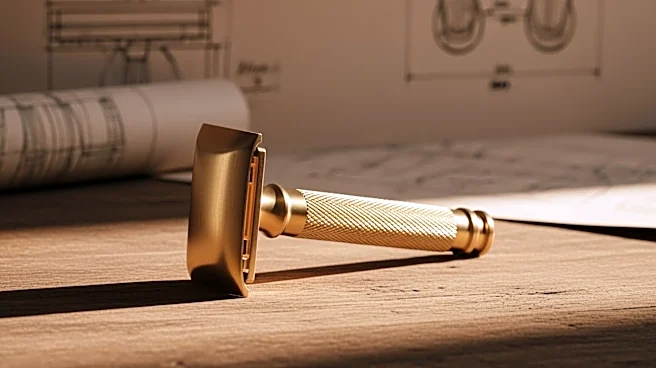










The safety razor, a staple in personal grooming, has undergone significant transformations since its inception. Designed to make shaving safer and more accessible, the safety razor has a rich history marked by innovation and adaptation. This article delves into the historical development of the safety razor, highlighting key milestones and innovations that have shaped its evolution.
Early Innovations and the Birth of the Safety Razor
The concept of a safer shaving tool dates back to the 1700s when French
cutler Jean-Jacques Perret introduced a protective guard to the traditional straight razor. This early innovation aimed to reduce the skill required for shaving, making it less reliant on professional barbers. The term "safety razor" first appeared in an 1880 U.S. patent, describing a razor with a handle and a removable blade, a design that predated the patent itself.
The Kampfe brothers of Brooklyn, New York, were instrumental in the early development of the safety razor. In 1880, they patented a design that distanced the blade from the handle using a hollow metallic blade-holder. This design featured a flat plate with bars or teeth to ensure a smooth shave without cutting the skin. The Kampfe brothers' "Star Safety Razor" became a popular choice, setting the stage for future innovations.
King C. Gillette and the Rise of the Double-Edge Razor
A pivotal moment in the history of the safety razor came with King Camp Gillette's invention of the double-edge safety razor in the early 1900s. Unlike earlier models that required stropping and honing, Gillette's razor used disposable blades with two sharpened edges. This innovation not only simplified the shaving process but also made it more convenient and hygienic.
Gillette's double-edge razor gained widespread popularity during World War I when the U.S. Army issued Gillette shaving kits to servicemen. The returning soldiers continued to use these razors, driving consumer demand for replacement blades. This demand solidified Gillette's position as a dominant force in the shaving industry, and the double-edge razor became the predominant style of razor for decades.
The Advent of Cartridge and Disposable Razors
The 1970s marked another significant shift in the safety razor's evolution with the introduction of cartridge and disposable razors. These new designs featured blades embedded in plastic, offering a more convenient and user-friendly shaving experience. Wilkinson Sword's "Bonded Shaving System" and Gillette's twin-blade Trac II were among the first cartridge razors to hit the market.
The introduction of disposable razors by Bic in 1974 further revolutionized the industry. Unlike previous models, these razors were designed to be entirely disposable, eliminating the need for blade replacement. Gillette responded with the Good News disposable razor, which quickly gained popularity. The development of multi-blade cartridges, such as Gillette's Mach3 and Schick's Quattro, continued to push the boundaries of shaving technology, offering consumers a closer and more comfortable shave.
Modern Innovations and the Future of Shaving
In recent years, the safety razor industry has seen a resurgence of interest in traditional double-edge razors, driven by a desire for sustainability and cost-effectiveness. Modern manufacturers continue to produce double-edge razors, offering a wide range of designs and materials to suit individual preferences.
The introduction of powered razors, such as Gillette's M3Power and Fusion Power, has added a new dimension to the shaving experience. These razors use battery-powered vibrations to enhance the cutting action, although their effectiveness has been debated. Despite the proliferation of multi-blade cartridges, the classic safety razor remains a popular choice for those seeking a traditional shaving experience.
As the safety razor continues to evolve, it remains a testament to the enduring appeal of innovation in personal grooming. From its humble beginnings in the 1700s to the high-tech razors of today, the safety razor has consistently adapted to meet the changing needs of consumers, ensuring its place as a staple in the world of shaving.