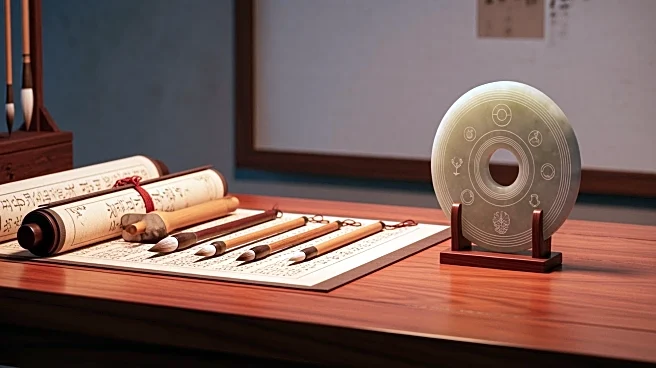




Chinese astrology is a fascinating system that has intrigued people for centuries. It is deeply rooted in traditional Chinese astronomy and philosophy, and it offers a unique perspective on fate and destiny. Unlike Western astrology, which often focuses on the positions of the Sun and planets, Chinese astrology incorporates a broader range of celestial and philosophical elements. This article delves into the historical and philosophical foundations
of Chinese astrology, highlighting its development and the key concepts that underpin it.
Historical Development
Chinese astrology has a rich history that dates back to the Zhou dynasty, which lasted from 1046 to 256 BC. During this period, the basic elements of Chinese astrology began to take shape. However, it was during the Han dynasty, from the 2nd century BC to the 2nd century AD, that Chinese astrology truly flourished. This era saw the integration of various elements of traditional Chinese culture, including yin-yang philosophy, the five elements (wuxing), and the concepts of heaven and earth.
The Han dynasty was a time of great intellectual and cultural development in China. It was during this period that the philosophical principles of Chinese medicine, divination, astrology, and alchemy were formalized. These principles were deeply influenced by Taoist, Buddhist, and Confucian thought, which emphasized the harmony between heaven, earth, and humanity. This holistic approach to understanding the universe is a hallmark of Chinese astrology.
Philosophical Underpinnings
At the core of Chinese astrology is the theory of the three harmonies: heaven, earth, and human. This concept reflects the belief that the universe is interconnected and that human fate is influenced by cosmic forces. The principles of yin and yang, which represent the duality and balance of opposing forces, are also central to Chinese astrology. These principles are used to interpret the positions of celestial bodies and their impact on human life.
Another key concept in Chinese astrology is the wuxing, or the five phases. These phases—wood, fire, earth, metal, and water—are seen as dynamic processes that interact with each other in a cyclical manner. The wuxing is used to understand the changing nature of the universe and to predict future events. This concept is not only important in astrology but also in traditional Chinese medicine and other aspects of Chinese culture.
The Role of the Chinese Zodiac
The Chinese zodiac is perhaps the most well-known aspect of Chinese astrology. It is based on a twelve-year cycle, with each year associated with a specific animal sign. This system was developed from observations of the orbit of Jupiter, which takes approximately twelve years to complete a full cycle around the Sun. Each animal sign is believed to have specific characteristics that influence the personality and fate of individuals born under that sign.
In addition to the animal signs, the Chinese zodiac also incorporates the ten Heavenly Stems and the twelve Earthly Branches. These elements combine to form a sixty-year cycle, which is used to calculate a person's fate based on their birth year, month, day, and hour. This complex system reflects the intricate nature of Chinese astrology and its emphasis on the interconnectedness of all things.
Chinese astrology offers a unique perspective on the universe and human destiny. Its rich history and philosophical foundations provide a fascinating lens through which to explore the mysteries of life.