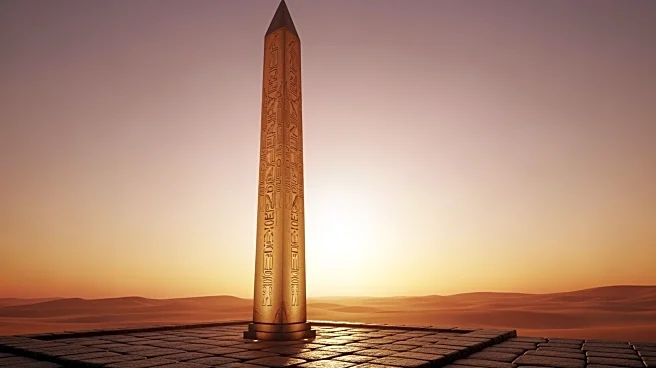




Cleopatra's Needles are two ancient Egyptian obelisks that have found new homes in London and New York City. Originally crafted in Heliopolis during the New Kingdom period, these monumental structures have traveled across continents and centuries, bearing witness to the changing tides of history. Their journey from Egypt to the West is a tale of political intrigue, cultural exchange, and engineering marvels.
Origins in Ancient Egypt
The obelisks known as Cleopatra's Needles
were originally erected in Heliopolis, a major city of ancient Egypt, during the reigns of Pharaoh Thutmose III and Pharaoh Ramesses II. These towering structures, inscribed with hieroglyphs, were symbols of power and religious devotion, dedicated to the sun god Ra. In 13/12 BCE, they were moved to the Caesareum of Alexandria by the Romans, marking the beginning of their long journey.
Heliopolis was a significant religious center, and the obelisks were part of its rich architectural heritage. The Romans, after their conquest of Egypt, transported many of Heliopolis's obelisks to adorn cities in the Delta and Rome. Cleopatra's Needles stood in Alexandria for nearly two millennia, witnessing the rise and fall of empires and the ebb and flow of cultural influences.
The 19th Century Relocation
The relocation of Cleopatra's Needles to London and New York City in the late 19th century was a feat of engineering and diplomacy. The London needle was presented to the United Kingdom in 1819 but remained in Alexandria until 1877, when Sir William James Erasmus Wilson sponsored its transportation. Similarly, the New York needle was secured by Elbert E. Farman, the United States Consul General at Cairo, and transported by Henry Honychurch Gorringe.
These relocations were not merely acts of cultural acquisition but also symbols of international relations. The obelisks were gifts from Egypt, reflecting the diplomatic ties and mutual interests between Egypt and the Western powers. Their transportation involved complex logistics, including custom-built ships and innovative engineering solutions to move these massive stone structures across the seas.
Modern-Day Landmarks
Today, Cleopatra's Needles stand as iconic landmarks in London and New York City, each with its own story to tell. The London needle is situated on the Victoria Embankment, while the New York needle resides in Central Park, near the Metropolitan Museum of Art. Despite the challenges posed by weather conditions, these obelisks continue to captivate visitors with their ancient inscriptions and historical significance.
The presence of Cleopatra's Needles in these modern cities serves as a reminder of the enduring legacy of ancient Egypt and the cultural exchanges that have shaped our world. They are not just relics of the past but living symbols of the connections between civilizations, bridging the gap between history and the present.