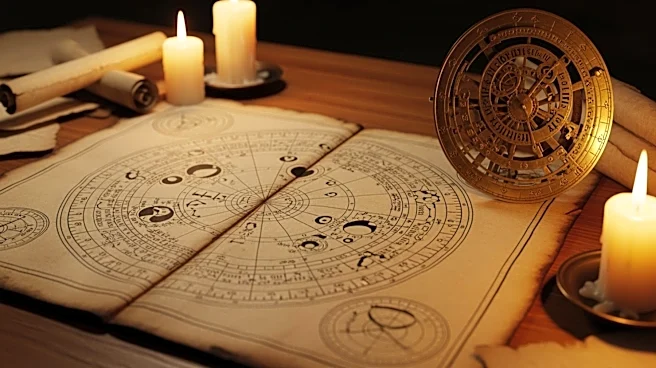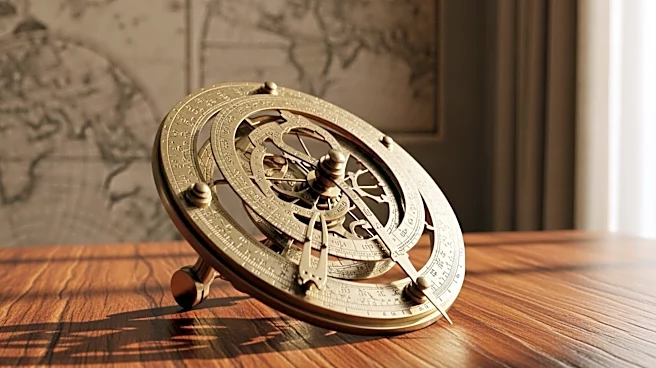





Declination has been a cornerstone of astronomical measurement for centuries, providing a means to locate celestial objects in the sky. This article delves into the historical context of declination, tracing its origins and evolution in astronomical practice.
Origins of Declination
The concept of declination dates back to ancient times, with its roots in the Latin word 'declinatio,' meaning 'bending away' or 'bending down.' This term reflects the measurement of how far a celestial
object deviates from the celestial equator. The celestial equator itself is an imaginary extension of Earth's equator into space, serving as a reference line for celestial navigation.
In the 18th and 19th centuries, declination was often expressed as North Pole Distance (N.P.D.), calculated as 90 minus the declination. This method provided an alternative way to describe the position of celestial objects, particularly in historical astronomical texts. The use of N.P.D. highlights the evolving understanding of celestial coordinates and the efforts to refine astronomical measurements.
Declination in Historical Astronomy
Declination has played a crucial role in the development of astronomical systems, particularly the equatorial coordinate system. This system, which pairs declination with right ascension, allows astronomers to map the sky with precision. Right ascension is comparable to longitude, while declination is analogous to latitude, together forming a comprehensive framework for celestial navigation.
The historical significance of declination is underscored by its use in various astronomical texts and observations. As astronomers sought to understand the movements of celestial bodies, declination provided a reliable means to track their positions relative to the celestial equator. This measurement was essential for creating star maps and predicting celestial events.
Evolution of Declination Measurement
Over time, the methods for measuring declination have evolved, reflecting advancements in astronomical technology and understanding. The introduction of sexagesimal measure, using degrees, minutes, and seconds, standardized the way declination is expressed. This system allows for precise calculations and comparisons across different epochs.
The Earth's axis undergoes a slow rotation known as precession, completing one circuit approximately every 26,000 years. This movement affects the coordinates of celestial objects, necessitating the use of epochs to specify their positions accurately. The current standard epoch is J2000.0, which corresponds to January 1, 2000.
Declination remains a vital component of astronomical practice, providing a historical link to the methods and measurements of the past. As technology continues to advance, the principles of declination continue to guide astronomers in their exploration of the universe.